You earned the respect of the world. What a legacy you have left. You will never be forgotten.
Author: siskinbob
Formerly employed by MOD and IBM, now retired
Classic Car Sunday – Goodwood

Last Sunday, the Goodwood Motor Racing Circuit held the latest episode of their popular Breakfast Club series. These meets, as mentioned in a previous post, are held on the first Sunday of every month. And best of all, entry is ticketed, but free.
Once again, thanks to the prolonged dry spell that the UK is experiencing, the weather was perfect. Blue cloudless skies allowing the bright sunshine to show of the varied paint finishes and, in some cases, the imperfections.
Here are just some of the photos I captured. First up a selection of vehicles, presented by the Amberley Museum & Heritage Centre.

Bedford – 1936

A Pair of Leyland Titan Buses – On the left and example from 1965, the one on the right is one from 1964
Southdown Motor Services ran bus and coach services throughout East and West Sussex. The company was formed in 1915.
I guess there may be a slight delay while the “great British workman” has a tea break.


Austin A4 – In rally trim.

1969 Morris Mini Van – In the livery of Yarty Cordials
If my memory serves me right, the Austin A40 was the first British hatchback.
One of the most iconic of British marques is the Aston Martin. To be honest, there were so many Astons on display, I became a little blasé so I chose to post just this example, because of the fabulous colour.

1966 Aston Martin DB6 Vantage

1966 Aston Martin DB6 Vantage
The same was to become true for the number Jaguar E-types. Don’t get me wrong, I love to see them and I am really pleased to see so many classic cars being lovingly looked after.
But ever onwards, so much more to see and not all high end or high performance. For example…

Austin Gypsy

1950 Cadillac 61 Series – DW Racing Livery

1955 Lotus Six

1955 Ford Thunderbird

1955 Ford Thunderbird

1950 Cadillac “Le Monstre” Tribute

1958 Fiat Abarth 750

1955 Ford Thunderbird

BMV 3.0 CSL

1955 Ford Thunderbird

1986 Citroen 2CV

1950 Cadillac 61 Series – DW Racing Livery

1955 Ford Thunderbird

1950 Cadillac “Le Monstre” Tribute

1958 Fiat Abarth 750

1966 Unipower
As I said above, not all of the vehicles on display are of the performance variety. Many, like the Ford Anglia “danglebox” below, were the cars that youngsters of my era started out in. And just like the young of today, we were not averse to “pimping” our rides. Fat tyres, lowered suspension, flared wheel arches etc. etc.

2016 Superformance GT40

1961 Ford Anglia

1967 Austin Healey 3000 Mk III

1959 Austin Metropolitan

1959 Austin Metropolitan

1987 Ford GT40

1968 Triumph TR5
The Austin Healy 3000, was my favourite “sports car” of all time. As a teenager, living in Battle, back in the mid-sixties, I used to see an aubergine 3000 with fat tyres, roll bars and bonnet straps. I really thought it was the business. And it has stuck with me right thru to my mid-sixties.
Sometimes, when the mood, light, atmosphere is just right a car will grab you. This, for me was the car of the day although the folks that were judging todays entries thought otherwise. What do they know ?

Bentley 4.25 litre Tourer

1938 62 Bentley 4.25 litre Tourer

Bentley 4.25 litre Tourer

Bentley 4.25 litre Tourer
This car has presence, poise, curves, is simply put, just beautiful.

1929 Ford Model A ?

1965 Gordon Keeble

2016 Superformance GT40

1966 MG Magnette

1948 Land Rover

1929 Ford Model A ?

1962 Sunbeam Rapier

1973 Jensen Healey

1973 Lotus Elan plus 2

1966 MG Magnette

1965 Gordon Keeble
Who remembers Barracuda by Heart , well here is the car. And, yes, I know it is also a fish with very sharp teeth. Looking under the “hood” I’m pretty sure this car has the automotive equivalent of teeth.

1970 Plymouth Baracuda

1970 Plymouth Baracuda

1970 Plymouth Baracuda
We had arrived at around 07:30 and the number of display cars kept on growing. From a photo stand point we aren’t even half way round. It’s interesting as we stroll along, how often we are saying stuff like “my Dad had one of those” or “that was my first car” or “we had one of those in blue” etc. etc. etc. A real nostalgia trip.

1967 Fiat 500

1957 Austin A35 – Somewhat modified !!

1959 Porsche 356

1924 Bugatti Type 35 – A Veyron prototype ?

1969 VW Karmann Ghia

1969 VW Karmann Ghia

1969 Ford Cortina Mk2
I should point out that Goodwood is an active airfield, so an unexpected bonus was a number of planes flying in and out. Including these …


But, hey, this post is about automobiles, so back to the main event …

1970 Morris Minor – Far from original with a Rover 3.5L fitted

1935 Bentley

1965 VW Camper

1935 Bentley

1970 Morris Minor – Far from original with a Rover 3.5L fitted

1965 Ford Mustang

1950 Bentley

Alvis

1968 Porsche 911

1974 Citroen DS

2003 DAX Cobra

1947 Bentley

1958 Austin Healey Sprite

1952 Citroen Traction Avant

1935 Bentley

1935 Bentley

1964 Austin A40 & 1957 Austin A35

1965 Austin Westminster Mk II

1974 Citroen DS

1953 Riley RM

1972 Jaguar E-Type

1939 Oldsmobile

1968 Jaguar E-Type

1967 Chevrolet Corvette

2003 DAX Cobra

1970 Morris Minor – Far from original with a Rover 3.5L fitted

1939 Alvis Speed 25 ?

1965 Austin Westminster Mk II
As you can see from the photos, the variety of vehicles on display was vast. The selection that I am posting here is just a fraction of the shots I took and is really only a taster of the caliber of this event.

1962 Lancia Flaminia Sport

1954 Jaguar XK120

1958 MG Magnette

1955 Triumph TR2

1965 Pontiac Bonneville

1949 Dodge Pickup

1970 Dodge Coronet


1965 Alfa Romeo Giulia

1965 Pontiac Bonneville

Ford Capri

1963 Alfa Romeo Giulia

1973 Hillman Imp – Heavily modified

An Ageing Moddy Boy

1969 Triumph Herald 13/60

1974 Morris Marina TC
And that is it folks. I hope I haven’t bored you with number of images. I am just amazed and the quality of the vehicles on display. The condition and finish is just a surface visual indication of the love that their owners lavish on them. We musn’t forget the mechanics underneath that classic bodywork.
I thank the owners for bringing their pride and joy along for my pleasure and I also thank the folks that organise these breakfast meets.
The next breakfast meet is Japanese Sunday, on October 7th. I hope to be there, let’s hope the weather is kind again.
Staunton Country Park Farm
A few days ago we spent a cracking day with some of our grand children. We visited Staunton Country Park Farm, a calm oasis just a short distance out-of-town. Calm that is, if you ignore the general hubbub of the excited children feeding the animals or in the play park.
From the Staunton website ….
Our farm, based on the 1830s style ferme ormeé (ornamental farm), is home to many different animals. Ranging from the everyday farm animal, like pigs, sheep, Shetland ponies, and chickens, to a selection of other animals such as llamas, a Poitou donkey and alpacas.
Here are just a few snaps that I took between pushing grandchildren on swings or carrying the youngest. Operating a Canon EOS 7D Mk II single-handed is no mean feat, weighing, as it does, nearly as much as my great-grandson.
So, for your delectation and delight ….

Flowers in Walled Garden

Flowers in Walled Garden

Happy as a Pig in Mud

Flowers in Walled Garden

Goats, goats and more goats

Fallow Deer and Goat

Goats, goats and more goats


Piglets and Mum

Boo !!!

Goats, goats and more goats

Goats, goats and more goats


What’s in there ?

Ice Cream Smile

Alpaccas and Llamas

Goats, goats and more goats

The only way to sound the horn is to head butt it

Pygmy Goat

Alpaccas and Llamas

Flowers in Walled Garden


Goats, goats and more goats

Goats, goats and more goats

Heavily Pregnant Cow

Alpaccas and Llamas

Turks Turban Squash


Alpaccas and Llamas

Feed Me, Feed Me Now
All in all a great place to take young children.
The farm is just part of the greater country park which has walking and cycling trails as well as three permanent orienteering courses. In the past we have hired bikes and explored the park. Sadly they no longer do the bike hire.
Staunton Country Park is a real gem and right on my doorstep.
Weald and Downland Living Museum
I am the eldest of three siblings and have two younger sisters. Years ago, due to job seeking, I moved away from the family home, in Sussex, eventually settling in Hampshire. Only 90 miles or so away, but far enough that our get togethers are irregular at best. We all have busy lives and trying to coordinate a gathering around our diaries is like herding cats. What we tend to do is pick a place of interest, somewhere between our respective homes, then meet up for the day. The main criteria being that there are nice walks in the grounds, interesting stately homes to explore and so forth. Also key is that there is a decent cafe / tea room or pub. Past venues for these family gatherings have been:
- Chartwell – Family home and garden of Sir Winston Churchill. Chartwell was the much-loved Churchill family home from 1922 and the place from which Sir Winston drew inspiration until the end of his life
- Nymans – A garden lovers’ home for all seasons, with an extensive yet intimate garden set around a romantic house and ruins. Nymans was a country retreat for the creative Messel family, and has views stretching out across the Sussex Weald
- Wakehurst Place. Part of the Royal Botanic Gardens Kew, this wild botanic garden on the High Weald of West Sussex has over 500 acres of beautiful ornamental gardens, woodlands and a nature reserve. Wakehurst is also home to the Millennium Seed Bank, the largest wild seed conservation project in the world.
- Bodiam Castle – Archetypal 14th century moated castle with ruined interior – a glimpse of medieval splendour. Set in the heart of an historic landscape, with spiral staircases, battlements and a portcullis, 14th century Bodiam Castle is one of Britain’s most picturesque and romantic ancient monuments.
And so we come to our latest gathering.
The venue of choice on this occasion was The Weald and Downland Living Museum. In their own words
Come and discover rescued rural homes and buildings set in a beautiful landscape, which tell the stories of the people who lived and worked in them over 1,000 years.
Enjoy our family friendly 40-acre site and visit our collection of historic buildings – we have more than 50 to explore from a replica Anglo-Saxon hall house to an Edwardian tin tabernacle church. There is a regular programme of demonstrations, including milling in our 17th century watermill; cooking in our Tudor kitchen; blacksmithing in our Victorian smithy; plus seasonal demonstrations. Take a walk in the woods, bring the dog (we are dog-friendly), visit our waterside café (also dog-friendly) or enjoy your own picnic.

As is our normal practice, we met in the cafe, and set about orienting ourselves while downing a cuppa.
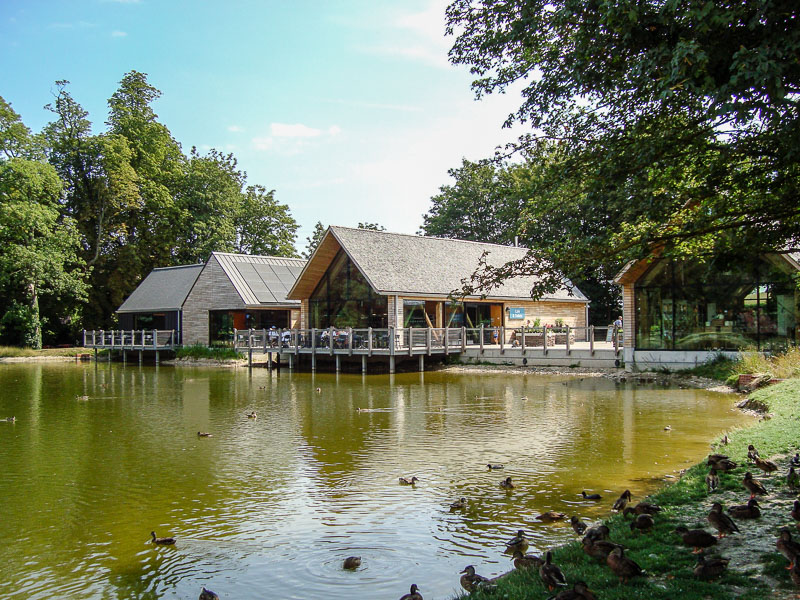
The nice thing about this location, is the fact that it is constantly growing. Gerry and I have visited on several previous occasions and it is always different, there is always something new.
A prime example of the new is the dairy building below. Still under construction / restoration, this building dates from c1807 and originates from Eastwick Park, Surrey.

Dairy – Eastwick Park, Surrey

Dairy – Eastwick Park, Surrey
As stated above, there are over 40 acres of grounds with buildings spread all over. From my memory, one of the earliest buildings that we have visited is the mill.

Lurgashall Watermill – Power source

Lurgashall Watermill – Spares ?

Lurgashall Watermill – The power from the wheel goes here.

Lurgashall Watermill

Lurgashall Watermill – Hands on demonstration. One hours hand grinding would produce enough flour for a single loaf.
The Weald and Downland Museum regularly appears on TV and there is a current series being broadcast. As they were filming something for that series part of the site was off-limits. Didn’t stop me taking a couple of pictures though.

Filming inside Wiston Wagon Shed

Court Barn from Lee-on-Solent
My grandfather worked the land, using horses, in the county of Sussex around Lancing, Worthing and Sompting. It is entirely possible that he may have visited this Victorian Smithy, from Southwater, during his working years.

Victorian Smithy from Southwater

Victorian Smithy from Southwater

Victorian Smithy from Southwater

Victorian Smithy from Southwater
We should consider ourselves very lucky, with all the technology and heavy machinery at our disposal. Back in the day things were very different, the work hard and often back-breaking. For example, does anyone fancy working a saw-pit ?

At least the workers would have had shelter from the rain or sun. The building here is 19th century and provided cover over a permanent saw-pit on the Sheffield Park estate.
Some of the hard labour was delegated to animals. Here is an example of a 19th century “horse-gin” from Patching, Sussex.

“gin” appears to be a contraction of the word “engine”. Such devices were used to drive threshers or churns, but could also be used to pump water or raise coal or miners from mines. The example below was used to mix the “pug” for making bricks.

Not all the buildings here are industrial or agricultural. After all that physical labour the spiritual needs of the workers would have to be catered for.

South Wonston Church – Built 1908, 30 feet long by 15 feet wide

South Wonston Church – Built 1908, 30 feet long by 15 feet wide
Many trades are reflected in the various buildings here, plumbing ….

Newick Plumbers Workshop

Newick Plumbers Workshop
shop-keeping ….
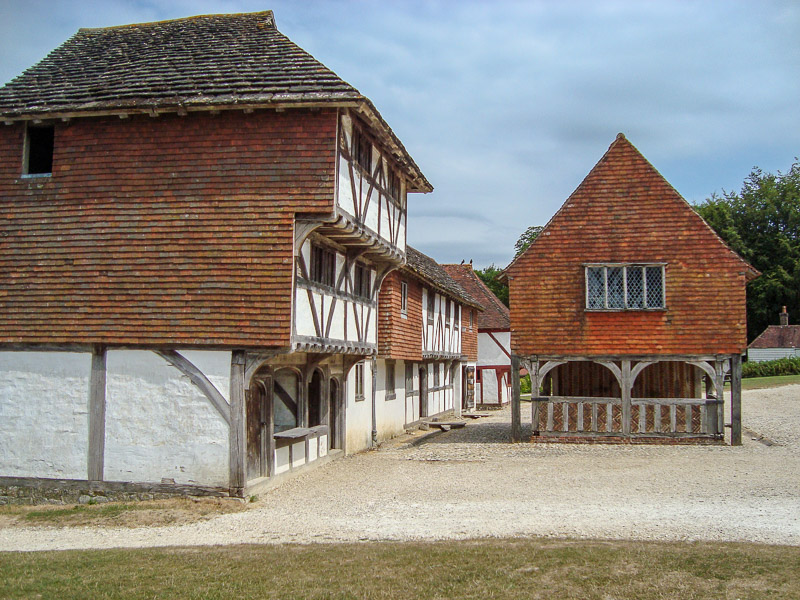
Also on display are a number of residential buildings. The following pictures are of Whittakers Cottages, built in Ashtead during the mid 1860s.

Whittakers Cottages – Bedroom

Whittakers Cottages – Bedroom

Whittakers Cottages – Privvy

Whittakers Cottages – Bedroom

Whittakers Cottages

Whittakers Cottages – Privvy
Also on display are various wagons, animal boxes and so forth….

Sussex Wagon

Dorset Wagon c1848

Cattle Transporter built 1911

Timber “Bob” – Used to haul large logs
This house was removed and resurrected from Walderton, Sussex. The flint and brick exterior date from early to mid 17th century. However, the insides are what remains of a medieval timber-framed building.

Garden of 17c House from Walderton, Sussex

Garden 17c House from Walderton, Sussex

17c House from Walderton, Sussex

17c House from Walderton, Sussex
Below is a 19th century Stable from West Wittering, currently be used as a Potting Shed …

Potting shed contents

Potting shed contents

19th Century Stable from West Wittering. Now being used as a potting shed
The following building was originally a cart shed but it was converted into a schoolhouse.

School c1851 – West Wittering

School c1851 – West Wittering
For some years up to 1851 it was used as a school for “six poor children from the parish of West Wittering”.
The museum is also home for a number of animals including horses, oxen, chickens and ducks.


This is the proud Percheron mother of a foal, just two and a half weeks old.


By the time we arrived at the foals enclosure a storm was moving in. Thunder rumbling and lightening flashing. The foal didn’t seem to be fazed by the noise but mum was obviously aware. When the rain started, the foal was frolicking around, galloping and leaping in the air. Considering that the foal had never experienced rain this was a joyful moment.
With the rain looking like it was in for the remainder of the day we headed along the high path back to the cafe. We were presented with the following views through the rain …


Back at the cafe we had a nice cuppa and a slice of flapjack before saying our good-byes and heading home.
It was a good day and I for one am looking forward to the next visit.
A Doer Upper ?
For some time now, I’ve been considering getting myself a boat. Partly as a project to fill my time and also so that I can have some fun and go fishing.
So, I sort of stumbled on this beauty and thought that it would be an ideal “doer upper”.
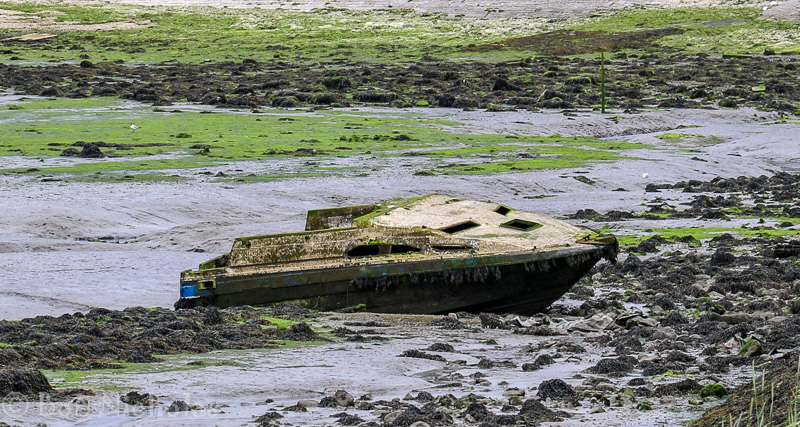
I’ve already thought of some names, Mud Skipper, Kelpie or maybe Slick.
What do you think, should I go for it ?
Flaming June
The month of June is quite often referred to as “Flaming June”. Depending on the weather this can be either a positive description or a negative one. This year I believe this description would be delivered as a positive.
The weather has been predominantly good, much to the benefit of the roses. Here are a few from my garden.


Yet Another Squirrel Picture
Over the last few weeks I have loaded up two of my bird feeders with around 2 kilos of sunflower hearts. One feeder has a stainless steel mesh and is mainly frequented by the various members of the tit family. Supplemented by the occasional visits of a pair of Nuthatches and Robins. And today we even had a Bullfinch, a first for us.
The other feeder is a little more open and needless to say is the preferred food source for, yep, you guessed it. The squirrels …..

I wouldn’t mind, but in stealing the birds food they spill more on the ground than they actually eat.

This ground based bounty then attracts the attention of those flying pigs, the Wood Pigeons. I call them pigs because of the volume of seed a single pigeon consumes. I also refer to them as vultures, as they sit high up in the trees waiting for us humans to leave the garden so they can come down and scavenge. They remind me of that old cartoon and tee shirt design …..

One day they will lose their patience, fly down and attack me instead of waiting for me to fill the feeders.
Anyway, I know, it’s my fault, I bought the wrong type of feeder. But I have yet to find a squirrel proof feeder. These little scallywags have such sharp teeth and are so persistent, that they have chewed their way into every feeder that doesn’t give them instant access to the food, like the one above.
Like us humans and our money, who want instant access to our cash. We have ATMs, the squirrel community want ASDs. Automated Seed Dispensers.
The Bluebell Line
Continuing a theme of stepping back in time, today’s post is about the Bluebell Railway which runs between East Grinstead & Sheffield Park in East Sussex.
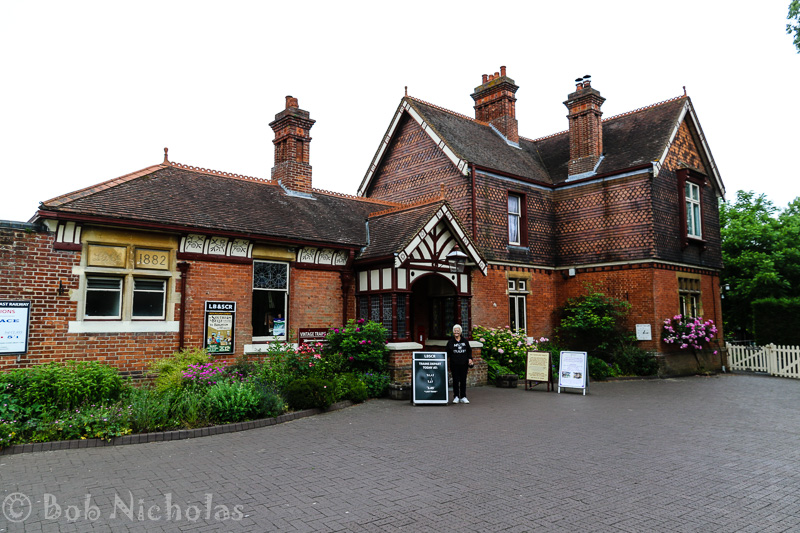
This was another “wrinklies” trip, organised by the IBM Retired Employees Club. And what a fine day out it was.
A coach trip through some of the finest countryside that Hampshire and Sussex have to offer. You see so much more from the high vantage point that a coach provides. Seeing much that is missed, hidden behind hedgerows when sitting in a car.
On arrival at Sheffield Park, we had time to wander the station, the gift shop and cafe.

Over to the right you can just make out a brown locomotive. This is the Fenchurch, the oldest engine on the Bluebell Line.

Bluebell Line – Fenchurch footplate

Bluebell Line – Fenchurch

Bluebell Line – Fenchurch
Fenchurch was built in 1872 for the London Brighton and South Coast Railway.

It was sold in 1898 to the Newhaven Harbour Company where it worked for many years. It finished its working life on the Hayling Island branch where the light weight, at 28 tons, was valuable due to the limits on the bridge over the estuary.
Whilst wandering the platforms, browsing the souvenir shop and raiding the restaurant for some chilled water, our train arrived.
The walls of the station buildings are adorned with the advertising posters of yesteryear, many stirring quite strong memories.


Back when there were 240 pennies to the pound !!!

Bluebell Line – Sheffield Park – Engine 847

Bluebell Line – Sheffield Park – Engine 847

Bluebell Line – Sheffield Park – Engine 847
Before we could board, the existing passengers had to disembark, and then the engine had to be moved from the one end of the train to the other.

Heading up to the front of the train

Switching the points

Disconnected from the train, reversing down to the points, to change lines.

Bluebell Line – Sheffield Park – “All change”, end of the line.

Heading up to the front of the train
While the engine swapped ends the carriage for our group was also being prepared for our luncheon. We were to enjoy a ploughman’s lunch and fresh brewed tea.

Carriage with destination board listing the stations on our journey

Time to take on some water. Hauling trains is thirsty work for our steam engine.
Once our engine was re-attached to our train there was just time for a few more shots before boarding.

The footplate for our engine is a bit more complicated that that of Fenchurch

Steaming

Engineering or Art ?

Each piece marked for this specific locomotive
And then we were off. Not the smooth running of todays diesel/electric trains. Rather a gentle pulsing which comes from the steam-driven pistons driving our locomotives wheels. Then there was the aroma, coal fire mixed with steam. Once experienced, never forgotten.
The line passes through some beautiful countryside. We saw cows, sheep, quite a few pheasants. I even saw, what I assumed was an owl box, shaped like the gable end of barn, mounted in a tree close by the railway.
We were sat across our table from a nice couple of gents with whom we nattered about all manner of subjects. We all enjoyed our ploughman’s lunch although perhaps it would have been more appropriate to have had an engine drivers breakfast. Bacon, sausage, eggs and toast cooked on a shovel in the firebox. But I guess that would have been too much to ask for. Even the tea could have made using steam from the boiler.
Ah well, perhaps another time. All too soon our journey was over and we all left the train and headed back to our coach for the drive home.

And finally, when we had a nationalised railway system, we all moaned and wished we could go back to the days of the independent and local railway companies. Now we have a national rail network with franchised companies running the trains. With the current, recurring railway network chaos headlining our newspapers and television news, it seems we are all wishing we had our old nationalised system under British Railways ……

Monty The Boat Horse
As an IBM retiree, I am a member of the IBM Retired Employee Club. The club organises various activities to keep us occupied, mainly via organised excursions. These activities can vary from shopping trips to London, mystery coach rides through the British countryside, shows and visits to stately homes.

A couple of weeks ago we did something a little different, for us. The scheduled excursion was a trip to the old market town of Marlborough, combined with a horse-drawn boat trip on the Kennet and Avon canal.
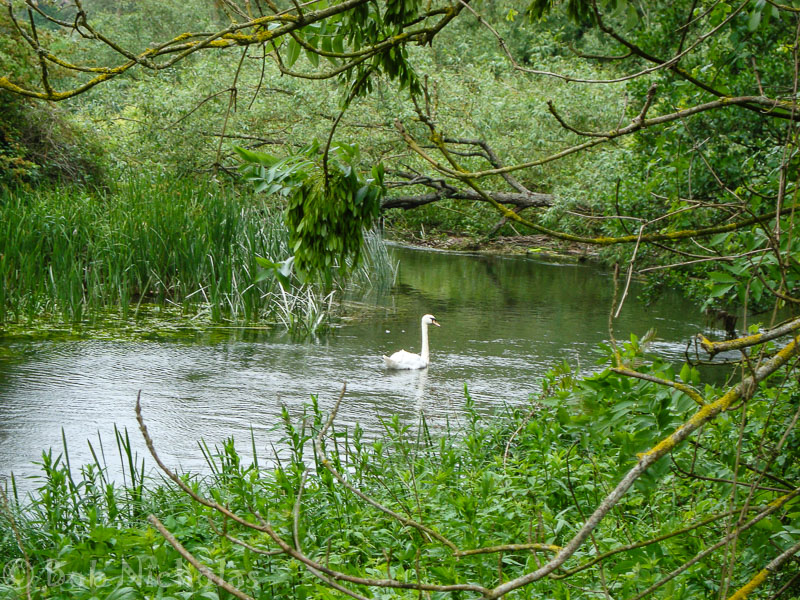
So, reasonably early in the morning, we set of on the coach. It was quite a dull day, in fact it rained quite hard as we drove down the M27. This didn’t bode well for the time we were due to spend in Marlborough. Plodding around shops is not my idea of fun. Doing it in the rain, even less so. However, 90 minutes or so later we arrived at Marlborough High Street, the second widest in Britain. The rain had eased off to a light drizzle so that was good.
Marlborough is an interesting town but, since we have visited several times before, we opted to spend very little time window shopping. Instead searching out a cozy hostelry, namely the Castle & Ball hotel, which dates from the 15th century. Here we had a very pleasant meal.
Having completed our lunch, we were soon back on the coach, ready for the days highlight, the boat trip. And, after a short, thirty minute drive, we arrived at Kintbury and were soon aboard the canal boat.

Our horse-drawn boat, Kennet Valley, is a wide-beam passenger vessel, purpose-built in 1976. She operates from Kintbury and is 20.4m (67ft) long by 3m (10ft) wide. Powered solely by the 1hp towing action of a horse.
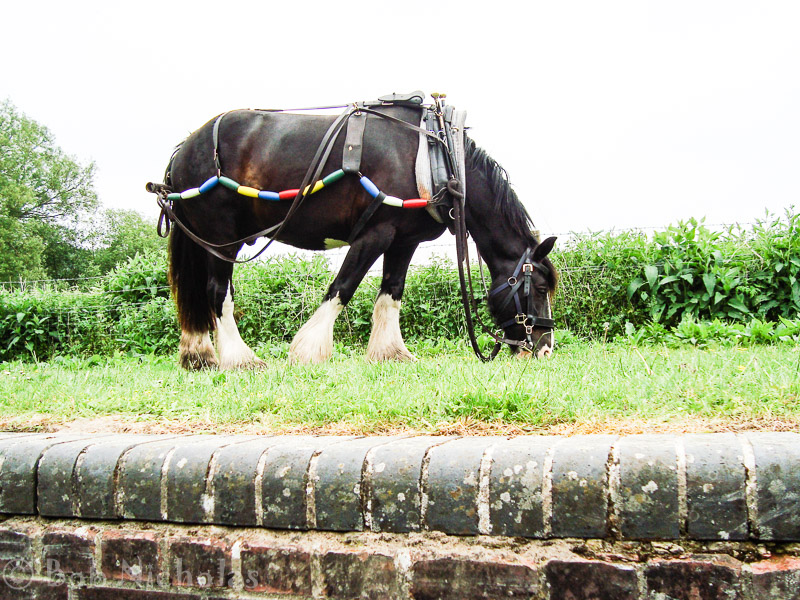
The horse in question is Monty ‘The Star’ a Welsh Cob Shire Cross. He was ready and harnessed when we arrived. Shortly, after all passengers were aboard, Monty was hitched up and off we went.

This is a fabulous way to travel. So smooth and quiet. Sometimes, there are obstacles to negotiate. The guys, our crew of three, were very adept. Lifting the tow rope over other craft moored alongside, so as not to take down their chimneys ……..
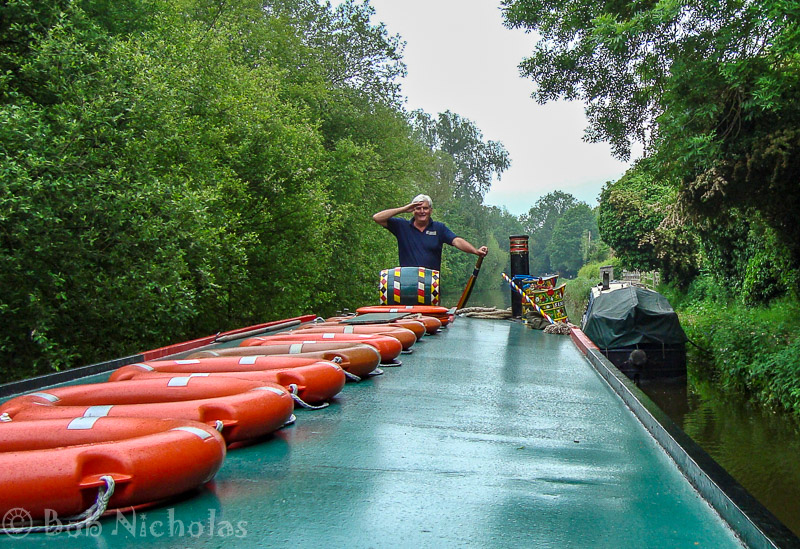
….. steering to avoid oncoming craft. Yes it was very busy. I think during our three hours on the boat we encountered two other craft coming towards us. I think the rules were that, since we were under horse power, they had to give way to us. …..
…. Locks are an intrinsic part of the canal way of life. During our journey we had two locks to negotiate each way ….
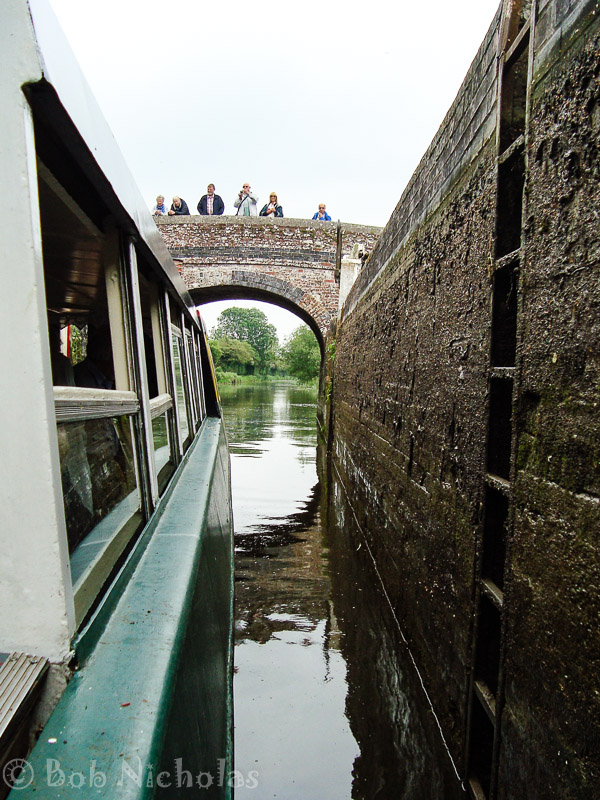
….. and bridges too.
Between locks, some of us decided to jump ship and walk alongside the canal. This was so relaxing.

If there hadn’t been some fifty odd passengers chattering away, this would have been a very quiet journey.
About half way through our journey, the galley was opened and we were served a fabulous tea. Hot tea and coffee along with Walnut Cake, Victoria Sponge and Lemon Drizzle Cake. Best of all we were treated to Fruit Scones with Cherry Jam and Cream. Surprisingly, the chatter level increased with everyone enthusing about the quality of the fare.
However, even with all that chatter, this was a lovely way to travel. No monotonous engine drone, no exhaust fumes, just the fresh country air. All accompanied by the bleating of lambs in the fields and the birdsong to join us on our gentle glide along the canal.

Monty walked steadily along, grabbing mouthfuls of grass and other foliage at every opportunity. Literally, foraging on the hoof. During our journey, we were regaled with tales of how, on a previous “wrinklies” trip, Monty did a runner. When Monty was un-hitched to allow the boat through one of the locks, he decided he had had enough and took off along the canal-side, all the way home. This left the boat stranded while the skipper trotted back home to retrieve Monty and bring him back to finish his days work.
On this occasion he behaved himself. Our journey was all to soon completed and we were back on the coach. Safely back to our departure point and then on to home.
A Great Day Out.
Woody
You can tell that the weather is warming up. The ants get busy and then along comes this great little guy….

This very smart bird is a European Green Woodpecker, Picus viridis.
He and his pals visit our front garden fairly frequently since we seem to have more than our fair share of ant nests. This member of the woodpecker family spends much of its time feeding on ants, on the ground. Unlike other species of woodpecker, he does not often ‘drum’ on trees.
They are supposed to be a shy bird but I have found them to be fairly tolerant so long as you don’t make any sudden moves. When they fly away they usually do so whilst emitting their very loud and distinctive call.

