Millau


So on Saturday we packed our bags and left the gite in Serandon. As, per my previous post, we had experienced a super storm during Friday night, the weather was calm but misty / drizzly.
Millau
Dordogne – Morning after the storm.

We wound our way down into the gorge and the first thing we noticed was all the debris, from the trees, strewn across the roads. And, as we climbed up the other side there were several areas where rock shale and mud had been washed down of the sides of the gorge, onto the road. Also, a number of trees were down but still being supported by electric cables. We eyed these with great suspicion as we maneuvered past them. Concerned that they would choose the moment of our passing as the time to drop completely.

As we wended our way towards Millau, the weather turned decidedly worse, until we were driving in torrential rain. Especially as we climbed up and down the various hills and gorges. As we travelled on the weather improved until, as we approached Millau, we were being treated to blue skies and sunshine.

The scenery in this region is fantastic and the more we saw the more we vowed that perhaps this would be the next region in France that we would target for our next long holiday.

Soon the reason for our trek to Millau popped into view.

The following is taken from the Aveyron Official Tourist Website

Millau viaduct holds the world record for the tallest bridge, culminating at 343 metres (higher than the Eiffel tower), 2460 metres long and touching the bottom of the Tarn valley in only 9 places.

Conceived by the French engineer Michel Virlogeux and designed by the English architect Lord Norman Foster, it fits perfectly into the naturally intact and grandiose landscape: a very thin slightly curved steel roadway supported by stays gives it the appearance of a huge yacht and the ensemble rests on 7 very slender pillars.

The bridge is spectacular and can be seen from many miles out. We took a few pictures, then headed for our hotel in Millau.

We were staying at the Hotel Mercure and were soon installed in our room. ow lucky were we with the room allocated to us. Take a look at the view from our hotel room ….

After a little freshen up we headed out to explore and grab a bite to eat. All the eateries near the hotel were only serving drinks. Once again our pursuit of lunch had commenced after the proscribed hours.  Pushing out, further afield and we discovered a brasserie, Le Mandarous, who were more than willing to take my Euros in exchange for food and drink. The brasserie was situated adjacent to a roundabout so we were able watch both human and automotive antics while we ate a rather tasty meal.

Millau13
Millau, France

I’m afraid I’m getting rather boring with regard to my choices. If it is on offer, I will almost always go for the “assiette de charcuterie”, an assortment of cooked meats which can including ham, garlic sausage, salami and, depending on the region, perhaps some cheese. Back in the Correze it was common to have Chèvres, Cantal or Salers. In Tulle there was Bleu d’Auvergne but on this occasion, in Millau, I was treated to a couple of pieces of a rather nice Roquefort. This was a real melt in the mouth treat.

After our meal we continued wandering the streets, sorry I mean exploring….

We both decided we liked Millau and felt that it would be a place we should visit again. With its quaint cobbled streets and narrow alleyways it has a really nice feel.

As we meandered into another square, Place Marechel Foch, we decided to take advantage of the shade provided by the trees and sat down for a cold beer from the nearby brasserie. We became aware of a wedding group gathering outside a nearby church.

Apart from the bride, page boys and bridesmaids there were numerous cars that had been decorated in perhaps, by UK standards, an unusual way. We liked it. Something else the French do is have the entire wedding group clamber into their cars and drive around the town honking their horns. Making everyone aware of the wedding and, I guess, involving everyone in their celebrations. There were several weddings on this Saturday afternoon in Millau and we had observed this tradition a couple of times around Serandon and Neuvic.Of course the Simca Rally Car did not need to sound his horn to make people aware as the engine noise was fairly noticeable.

Suitably refreshed we meandered our way back to the hotel for a brief nap before getting changed and heading out for our evening meal.

On the whole a good day.


Argentat


The plan was to travel to Argentat and, with detours en route, other towns and villages. Like I said, that was the plan and it remained the plan for about an hour.

The first detour was to a place called Belvedere de Gratte-Bruyere. Shown on our maps to be a view-point. The satnag refused to acknowledge that any such place existed. Luckily I had already spotted a sign in the centre of Serandon and so off we set.

The weather was beautiful and sunny so driving down the ultra quiet French lanes was a pleasure. The sun shining through the over hanging branches creating dappled shadows. Down one such lane we were suddenly presented with a view of a typical Chateau. I would have loved to get a shot of the front but it was not accessible. So you’ll have to make do with a back view…

Mystery Chateau - near Serandon, France
Mystery Chateau – near Serandon, France

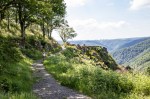
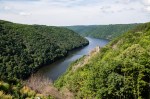
A short drive further on and we arrived at the Belvedere de Gratte-Bruyere which gives spectacular views along the “Haute Vallee de la Dordogne”.

Standing up there was like being in an eagles eyrie, like you are on top of the world. Very, very quiet, but for the movement of the air through the trees and the ever-present twittering of the birds.

Beautiful !!!

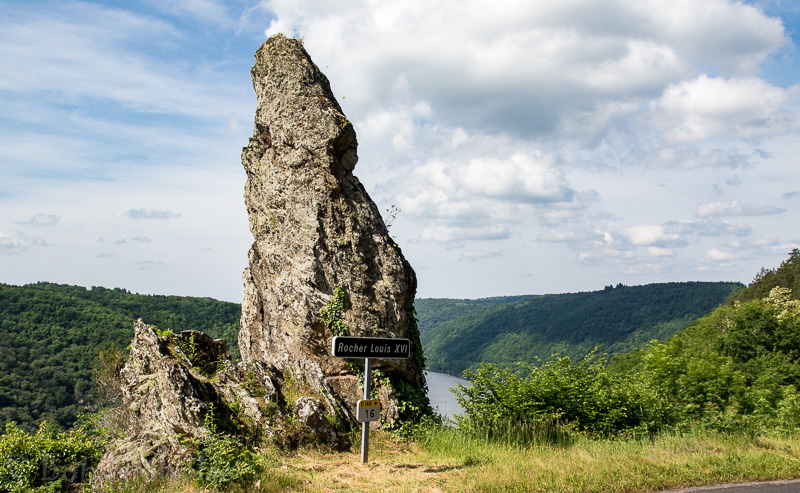
Continuing on towards Argentat our route took us down alongside the Dordogne and, a short distance from the belvedere, we came across a large upright rock formation …

Rocher Louis XVI
Rocher Louis XVI

So far I have not been able to find anything about the significance of this rock.

Driving as slowly as we were, with the windows open, you become aware of the many streams noisily tumbling down the sides of the gorges. One was large enough to warrant its own pull in and picnic tables ….

Falls - Dordogne, France
Falls – Dordogne, France

Very pretty, with the dappled shadows from the trees. We met some ramblers here, their two dogs were very pleased to drink from these chilly waters.

Having descended to the bottom of the gorge it was time to cross the Dordogne. The French Government had kindly placed a bridge at the end of the road, to ease our crossing ….

Pont des Ajustant - Dordogne, France
Pont des Ajustant – Dordogne, France

Although we were in the Dordogne Valley, the piece of water that this bridge crosses is in fact “La Triouzoune”.

According to Wikipedia “The Triouzoune is a 50.5 km long river in the Corrèze département, south-central France. Its source is on the Plateau de Millevaches”

Having crossed the bridge we were soon climbing up the sides of the gorge which continually presented photo opportunities along with chances for Gerry to show me how brave she is …..

Photo Opportunity - Not sure who for though
Photo Opportunity – Not sure who for though
Gorge-side Road - Dordogne, France
Gorge-side Road – Dordogne, France

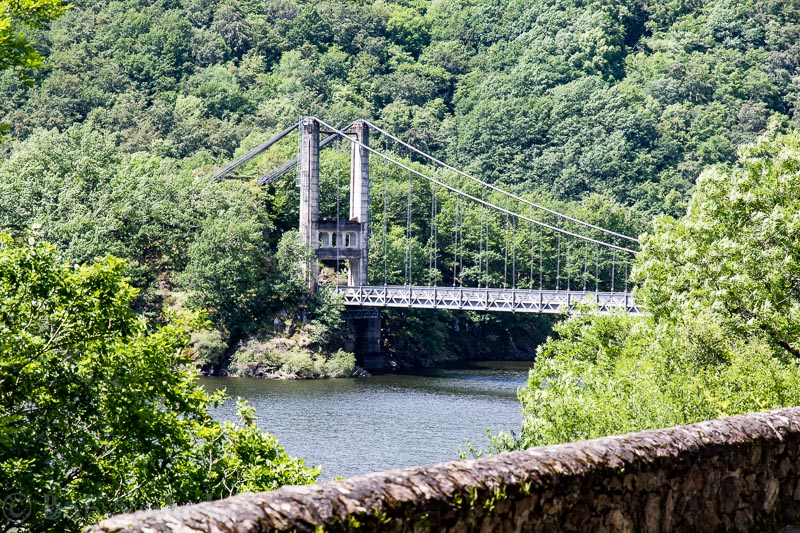
Soon we were crossing the water again, this time the Dordogne via  the “Pont Saint Projet”. A suspension bridge, which has a span of 195 meters and was built in 1945, following the creation of a dam some 5 km downstream from the bridge. More about the dam later. 

Pont Saint Projet - Dordgne, France
Pont Saint Projet – Dordgne, France

Apparently, below the bridge, swallowed by the newly formed lake is the village of Saint-Projet-le-Desert and also the fifteenth century convent Saint-Projet.

Climbing, once again, we burst out of the gorge into open fields and farmland and soon found ourselves in the village of Chalvignac. Very pretty but, as we arrived, under attack from a large contingent of school children. You’ll be pleased to know that French school children can make just as much noise as school children everywhere. Quite a contrast from the tranquility we had just been experiencing down in the gorge.

A few kilometers down the road and we found ourselves on top of Le Barrage De L’Aigle (Eagle Dam), the reason that the village of Saint-Projet-le-Desert found itself under water.

Built between 1940 and 1945, the dam created a lake, 16 miles in length. Three villages, La Nau, St Projet and Nauzenac, situated on the banks of the river, were all drowned. In Nauzenac, two inhabitants, who didn’t want to leave their house, were drowned by an exceptional flood during the night of the 7th of December 1944.

Apparently, the formal name of the dam, originates from a rock situated downhill from the dam. Needless to say we did not spot the rock.

Alternatively, the dam is called “the dam of the Resistance”, because it was used as a refuge for the maquis.

Maquis (World War II) – Wikipedia, the free encyclopedia

The Maquis (French pronunciation: [maˈki]) were rural guerrilla bands of French Resistance fighters, called maquisards, during the Occupation of France in World War II.

Some workers were involved both in the maquis and in the construction of the dam. These “workers” employed delaying tactics to the works so that the dam couldn’t be of benefit to the Germans.

On the downstream side of the dam there is a park with information boards and picnic tables, nice of the authorities to provide such a beautiful vantage point from which to relax and enjoy the view.

On the road again we stopped for a quick photo looking back up the gorge, towards the dam, looking over the village of Aynes.

EagleDam_france5
Looking up the gorge, towards Le Barrage De L’Aigle, looking over the village of Aynes

Pretty as the village is, I don’t think I could live so close below such a structure.

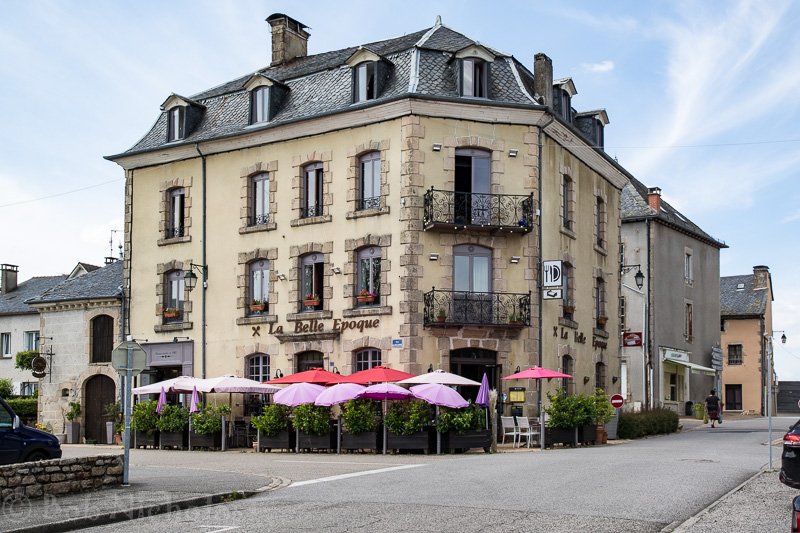
At the beginning of this post I said that our original plan was to visit Argentat. We had set out around 10:00 and by now it was after 14:00 and we started to think about lunch. Of course many country eateries close their kitchens for the afternoon, only opening again for the evening trade. And so we found ourselves in Saint-Privat at “La Belle Epoque”.

La Belle Epoque - Saint-Privat
La Belle Epoque – Saint-Privat

Due to our time of arrival,l we were informed that the kitchen was closed. However, they could still provide us with the “plat du jour”, which on the face of it sounded OK. A starter of Eggs Mayonnaise, a main of Sausage with cheesy mashed potatoes (so we thought) and a pudding of pannacotta.

The eggs mayonnaise were fine, not much to mess up there. The sausage and cheesy mash turned out to be sausage laid on a bed of cauliflower cheese with a sprinkling of fried mushroom slices. The oily juice from the mushroom frying was running around the edge of the cauliflower pile. It would have been OK if the sausage had been freshly cooked, but I suspect that it had been reheated in a microwave. Not an impressive meal. Gerry didn’t eat all of her main course and, of course, none of the panacotta. As it happens the panacotta was also OK.

I guess, as I previously mentioned, due to our timing, beggars can’t be choosers. Personally, I think I would have rather gone to a supermarket and bought bread and cheese. Lesson learnt, eat earlier or take a picnic.

We did, eventually, reach Argentat and very pretty it looks too. However, due to our meandering we didn’t feel we could do it justice and have earmarked it for a dedicated visit during the next two weeks.

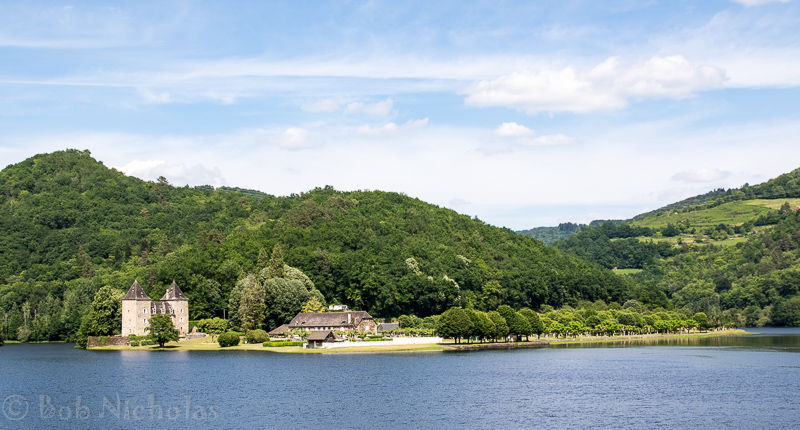
As we were leaving Argentat we spotted this Chateau, which must have one of the most idyllic settings one could wish for.

The Chateau du Gibanel

This place is now operating as a four star holiday site with provisions for camping, mobile homes or apartments.

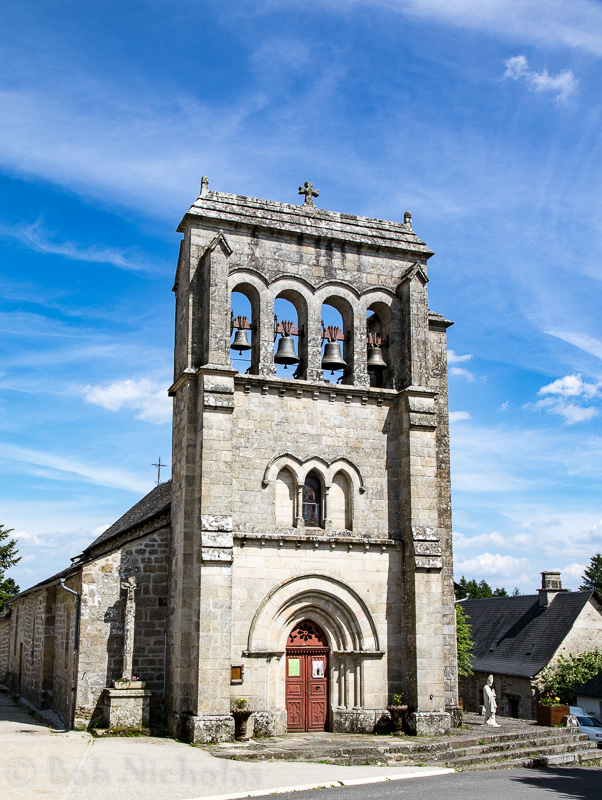
Still travelling back towards the gite, our route took us through the village of Saint-Martin-la-Méanne whose church has an unusual tower.

Saint-Martin-la-Méanne

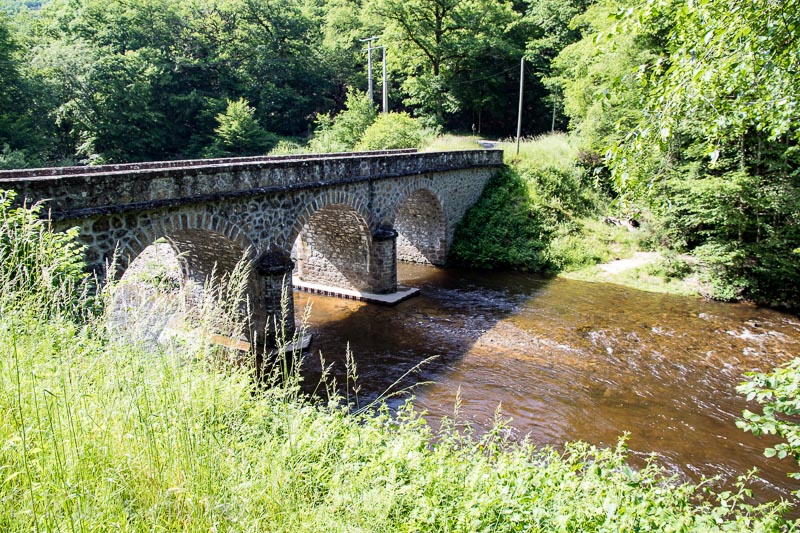
The village takes its name from its geographical position between two rivers, the Dordogne to the east, the Doustre to the west and a plateau of lakes and ponds in the North.One last photo from our grand tour. Not sure where it was but it needed to be recorded for posterity, whatever that is.

Bridge - Dordogne, France
Bridge – Dordogne, France

So, our day did not go as planned but turned out to be very pleasant. Even though the food at La Belle Epoque could have been so much better, it did not spoil the day. It was nice to be able to tour around on such quiet country roads, taking our time and stopping as and when the fancy took us.

It is the peaceful environment that attracts us to rural France. Long may it stay that way.


Tulle


Yesterday we ventured away from Serandon, took ourselves over to Tulle. Tulle is the capital of the Corrèze département in the Limousin region in central France.

For the drive across to Tulle the satnag offered us the choice of going via toll roads, or not. We chose not. The route was very pretty but, as expected, followed mainly minor roads as it cut across the gorges. We soon felt as if we were on an alpine rally as we negotiated hair-pin after hairpin, and as we climbed up to a peak before dropping down the other side to cross a busy stream.

En-route we passed the ruined fortress of Ventadour, sitting on a rocky promontory that we were negotiating our way round.

castle_France
Chateau de Ventadour

We will have to make a separate trip to visit this site.


We arrived in Tulle whereupon the satnag, having been programmed for the town centre, had another hissy fit and guided us through the centre, up and out the other side before claiming we had reached our destination. Assuming that we needed to be at the lowest point I ignored the satnag and we eventually parked, for free, right across from the cathedral.

For the uninitiated, Tulle is sometimes known as “the town on the seven hills”.  And those hillsides are very steep and every spare space is crammed with houses and businesses. It must make for some very desirable real estate but it also makes for many steep and winding roads.


Tulle was, historically, an important centre for lace production. It is the town where tulle, the finely woven material, often used for wedding veils, was invented.

Having parked up, and knowing the French penchant for towing vehicles, I enquired in the local pharmacy about parking fees. She informed me that for two, or maybe three, hours around lunchtime the parking was free. Certainly the parking ticket machines seemed to be in agreement. Both of the nearby machines were displaying “hors service” which translates to out-of-order.

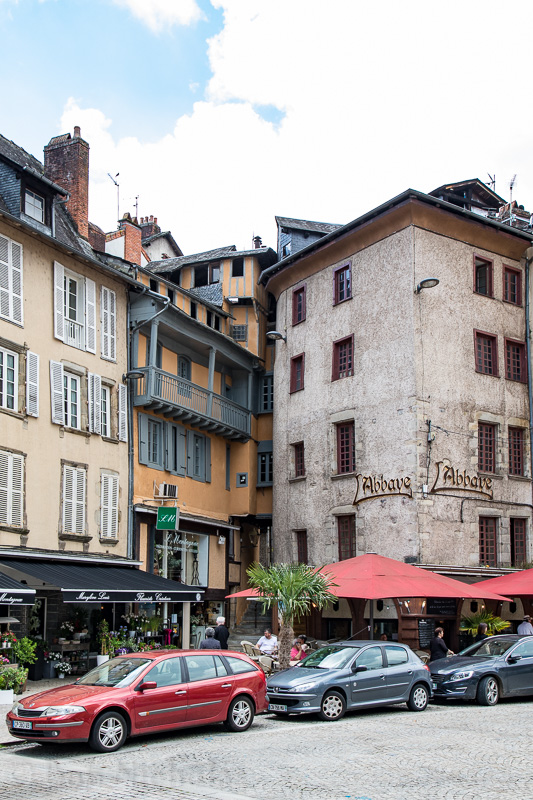
Since it was lunchtime, we decided to eat at L’Abbaye. Still unsure about the parking I asked the waiter. He pointed to the ticket machines and when I explained that they were both out-of-order, he shrugged his shoulders and said “then it is free”.

Tulle3
L’Abbaye – Where we had lunch

We had a very nice lunch, both choosing burgers which is an unusual choice for Gerry. She chose the “Classique” which boasted a hache steak made from Limousin beef with tomatoes and onions. I had the “Auvergne” which also comprised the afore-mentioned hache steak, but with Bleu d’Auvergne, one of my favourite cheeses. All washed down with a glass of biere pression (draft beer). Very nice.

While eating we had noticed two guys working on the ticket machines and, still nervous about the parking, we wandered over to check the machines again. Still out-of-order, so we set out to explore Tulle.

One of the items, on our list, to visit was the Cloister Museum at the base of the museum. Unfortunately, it was shut.

According to the sign it was to open at 14:00, however at 14:15 there was no sign of it opening so I took a couple of shots through the bars of the iron gate and we moved on.

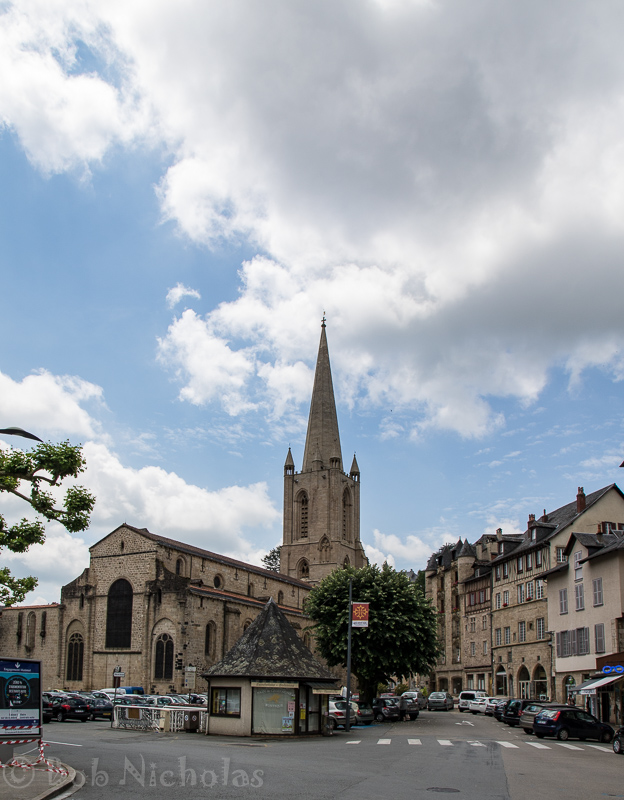
We opted not to venture inside the cathedral,

Tulle5
Tulle Cathedral (Cathédrale Notre-Dame de Tulle)

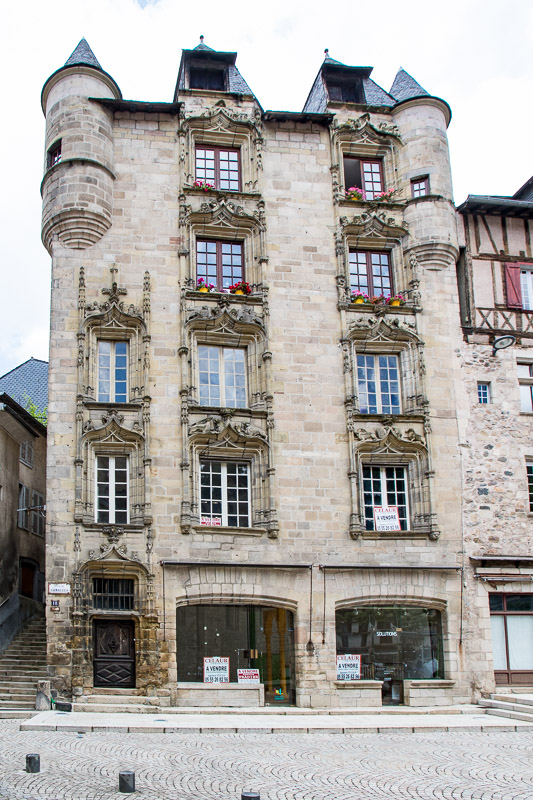
preferring to stay outside in the sunshine. Literally, just around the corner from the cathedral entrance is Maison Loyac.

Tulle2
Maison Loyac – Tulle

Dating from the 16th century it is decorated with sculpted motifs of plants, animals and occasionally figures in compromising positions. So says our guide anyway. See if you can spot them.

While in Tulle we raided the local tourist information office, lifted a few leaflets to  give us some ideas for future days out.

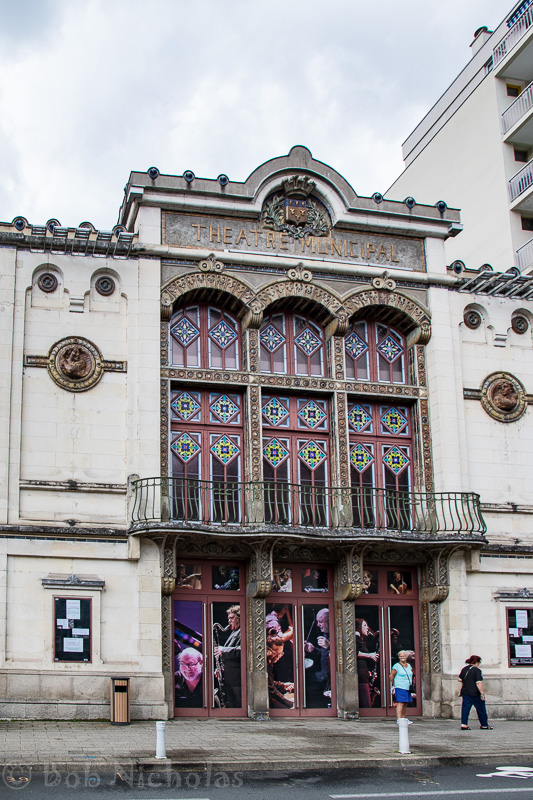
Tulle8
Municipal Theatre – Called th Theatre des Sept Collines, Built 1899

Another item on the list is the Municipal Theatre, also known as Theatre des Sept Collines (The Theatre of  Seven Hills). It was built in 1899 and, although built of reinforced concrete, it  has a beautiful facade decorated with enameled sandstone, busts and medallions in glazed plaster.

Medallion
Medallion, Municipal Theatre – Tulle

Mooching around on a warm summers day can develop a thirst, so we felt the need to stop for refreshments. Our chosen establishment, La Taverne du Sommelier. One beer and a coke later we were on our way meandering around Tulle.

A few more photo’s taken ….

…. and it was time to head back to the gite. A short detour into a boulangerie for a fresh loaf and we were on the road again.

Since we arrived in Serandon the local forecast has been threatening us with thunder storms and rain. Well it finally delivered the rain part of that deal, and made the first fifteen minutes of our journey unpleasant. As we travelled further east the rain disappeared and the skies brightened.

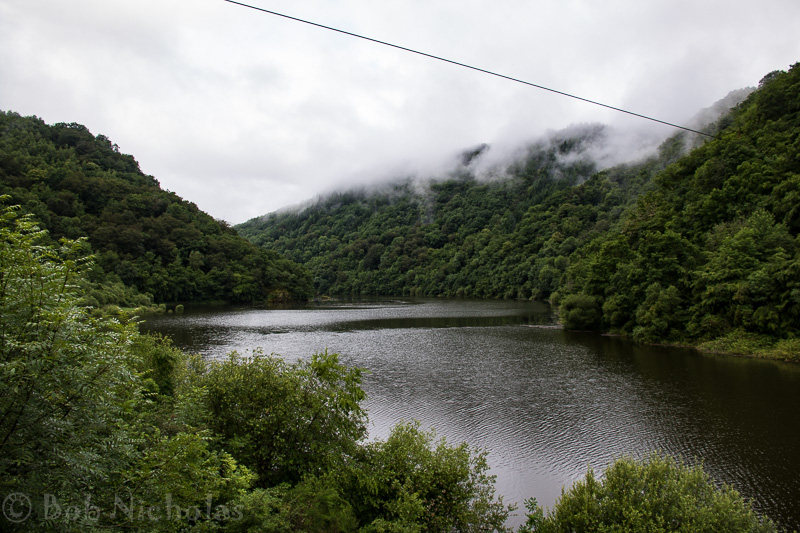
The evening back at the gite was very pleasant and I found myself watching the mists develop down in the gorges. Of course I had to go and take some, well quite a lot of, photographs. I’ve included a couple below ….

The shape and volume of the mist changes by the second and I could have stood there for ages. Well, actually, I did. I had to force myself to stop taking pictures, of the mist anyway.

Here are a couple of other shots taken while I was being mesmerised ….

Later this same evening the mists thickened until we were totally fog bound. The only reason I could see my car was that there was a street light right by it.

A suitable close to a great day.