We had a beautiful breakfast in a very elegant dining room. No mention was made of the cats shenanigans during the night. In fact it was nowhere to be seen. Well not until we were ready to leave. Then it appeared to cry its farewells on the front step.
Having loaded our stuff into the car we set of again, heading south. Our destination this time was La Souterraine, which was to be our last stop, before completing our journey to Aurillac and our gite at La Calsade, Badailhac.
As we were cruising along we commented on how few foreign cars we were seeing. More to the point, how few british cars. For obvious reasons on Friday when we crossed the channel, nearly all the cars were British. On Saturday that had significantly reduced to just a few Brits interspersed with Belgian and Dutch but mainly French. Here we were on Sunday morning and we felt we were the only foreign vehicle heading south. Occasionally, we would see a Dutch motor home, but it was very apparent that we were going to be in the minority for most of our holiday and that’s just the way we like it.
A little bit about La Souterraine …..
Stopping point on the Way of St James (Santiago de Compostela pilgrim route), the medieval town of La Souterraine has a rich history and boasts a beautiful heritage, with its granite church, its fortifications and its old houses.
Built from the 11th to the 13th century by the monks of the abbey Saint-Martial de Limoges, the Notre-Dame church combines both Romanesque and Gothic styles. Its crypt, a former Gallo-Roman churchyard, can be visited in July and August.
Once again our journey was trouble-free, that is until we tried to find our lodgings. Entering La Souterraine and approaching a roundabout, the satnag clearly told us to take the 3rd exit and then, almost immediately, hang a right. We were looking for house number 23 but the house numbers on this road, a cul-de-sac, only went up to 10.
Rather than spend time trying to unravel the satnag foibles we headed into the town centre for lunch and parked up in the car park by the church in the centre of town. As with our previous visit to this town, it appeared to be shut. We had previously visited, whilst en-route to La Porcerie where we had rented a gite five or six years ago.
Sleepy La Souterraine
La Souterraine
Notre-Dame – La Souterraine
Saint-Jean Gateway – La Souterraine
Saint-Jean Gateway dating from the 13th century, all that remains of the former ramparts.
La Souterraine
La Souterraine
So we headed up to the restaurant where we had lunch on that previous occasion, La Gondole sur le Toit. Thankfully it was open and still serving. Soon we were seated, our meal ordered and a nice beverage delivered.
La Gondole sur le Toit – La Souterraine
While waiting for our meal we checked out the B&B address on Google Maps, which confirmed that the house should be in the vicinity of where the satnag took us. We decided to enjoy our meal and then drive very slowly back to see if we could spot the navigational error.
And spot it we did. There appears to be a duplicate road, behind the one that our satnag directed us too. Once, spotted, we very quickly found the B&B, Maison Volière.
What a treasure it is. Built in 1877, the Maison Volière is perfectly placed, being just a ten minute walk from the town centre. But, remaining quite an oasis, hidden in the trees as it is. Our hosts Anthony and Ian (Mancunians) made us very welcome. Nothing was too much trouble for these guys. Our room (suite) was very spacious and the en-suite was equally huge.
It was Anthony who later informed us that La Gondole is the only restaurant open on a Sunday in La Souterraine, at lunchtime, or in the evening.
Needless to say, after our drive down from Chartres, a delicious lunch and a tour round La Souterraine we were ready for our bed, which was very comfortable.
After a good night’s sleep we were served breakfast in our delightful Wimereux Cottage. Breakfast comprised the usual continental selection of fresh breads, conserves, yoghurt, cheeses and ham. Especially tasty were the boiled eggs, soft, from the hens that had introduced themselves the previous evening.
Suitably refreshed, refueled and the bill settled, we reloaded the car and were soon on our way.
This next stage of our journey was to take us to Chartres. The journey was pretty much trouble-free and as I had scheduled our stops at around the three to three and a half hour mark we were soon entering Chartres. As we neared the city the grand bulk of the cathedral was silhouetted against the skyline, acting as a beacon, confirming that we were on track.
As we drove around looking for somewhere to stop, we became aware that the city centre was very busy. All along the pavements there were white kiosks. But instead of selling goods they appeared to be promoting leisure activities. There was some kind of job/leisure activities festival underway and they were promoting everything from local choirs through rock climbing and kayaking. There was even a stage where local musicians and dance schools were demonstrating their skills. All of this activity meant that there were no casual parking spaces available. We did eventually get parked up, in a permit only bay as we later found out. Luckily we were not discovered.
Anyhow, walking back to the centre took us right past our next accommodations. For the moment though we carried on, in search of an eatery. We were soon seated, outside in the sunshine, at an Italian restaurant. I know, we should have been eating French, but we were pushing the lunchtime kitchen clock to its limits. I think we were the last customers to get a lunchtime meal.
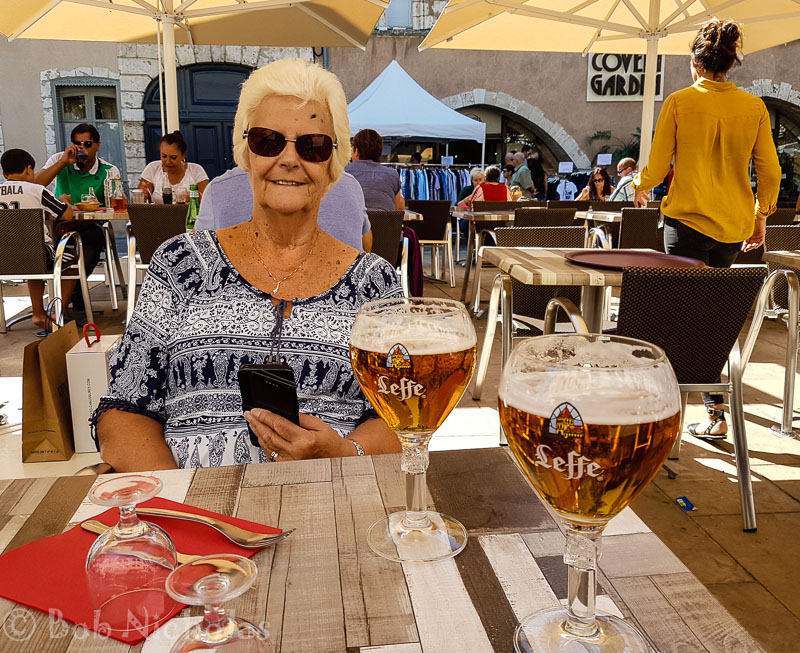
Chartres – A Refreshing Beer
The food was good and we enjoyed a little people watching while sipping our beer. After lunch we went for a wander around the streets, window shopping as well as admiring the, sometimes, quirky artworks along the way.
Chartres – Street Art
Chartres – Street Art
Chartres – Street Art
Chartres – Street Art
Then it was time to go check out the lodgings. From the outside the house was very grand, although, architecturally, it did resemble the “Munsters” house.
Chartres – Maunoury Citybreak
Chartres – Maunoury Citybreak
Having introduced ourselves to our new host, Anne, we were shown to our room on the second floor. Quirky would be one way to describe it. I don’t think that there was a square corner anywhere. Our en-suite was tucked away behind a wooden, tongue and groove, partition. In here was also some hanging space for clothes. The enclosed toilet was wedged between a wall and the end of the shower.
Still we were only staying the one night.
Chartres – Advocat Sign (Solicitors)
Chartres – View from our window
Chartres – View from our window
The good news was, with parking spaces being at a premium, Anne had a parking space for us, at an address just about fifty metres along the road. This was good, since we would be leaving most of our belongings locked inside the car, not hauing them up to our room. So we retrieved our car, parked up, unloaded our overnight bags and once installed in our room, took a short rest. I tried but couldn’t quite make it into naps-ville.
Another gem, that Anne had imparted, was the fact that we had arrived during the annual Chartres Festival of Light, a Son et Lumiere. Apparently, many buildings are lit and there is a light trail one can follow for a couple of kilometers. Most importantly, Chartres Cathedral takes a starring role. The performance was due to commence at around nine, as darkness descended.
We arrived at the Cathedral early and bagged ourselves a handy granite block to sit on. The show got underway and boy was it worth it. It only ran for about fifteen to twenty minutes, but was beautiful, with a musical soundtrack as well as a short history lesson given in both French and English. Had we felt inclined we could have sat through it again.
Chartres Cathedral – Son et Lumiere
Chartres Cathedral – Son et Lumiere
Chartres Cathedral – Son et Lumiere
Chartres Cathedral – Son et Lumiere
Chartres Cathedral – Son et Lumiere
Chartres Cathedral – Son et Lumiere
Chartres Cathedral – Son et Lumiere
But we moved on and found that a different light show was being projected onto the side of the cathedral. Ideal for those eating in the nearby restaurants. Having watched that for a while we moved on, in search of supper.
Supper turned out to be a savoury crepè filled with ham, cheese and a fried egg. Apparently it should also have contained potato, but the proprieter had run out of pomme de terre. Regardless, it hit the spot, washed down with a cup of tea. As we walked back to our digs we encountered a couple more illuminations although we didn’t feel we had the energy to search out all of the city’s illuminations on offer and were soon “home” at the B&B.
Chartres – Marche aux Legumes (Vegetable Market)
Entry to the B&B is via a code locked gate and then a code locked front door. As we entered the code for the front door we were intercepted by a very vocal cat. As soon as the door opened, the cat bolted inside and trotted up the stairs to the first floor. As we ascended we found the cat, crying at the door to Anne’s quarters. We carried on to our room on the next floor and were soon stretched out in bed.
Well we soon regretted letting that bloody cat in through the door, not that we had much choice. It cried and cried. Not getting any response from Anne, the bloody thing came upstairs and yowled outside our door. And then, not getting any response from us, it threw itself at the door. That gave us quite a start. The yowling continued for a while until it took itself downstairs again. Unfortunately, I had to get up and use the toilet. As soon as I hit the flush, that bloody cat started up again. Surprisingly, all the ruckous the cat was creating did not rouse the other residents on our floor. Nor did it rouse Anne or her family.
Needless to say our night was punctuated with cries throughout the wee small hours.
Just over a month ago we set off on holiday. And so it was that we found ourselves en-route to Badailhac in the Cantal region of France. We had rented a gite for three weeks and the intent was to spend our time exploring the countryside and sampling the local cuisine.
Although it is possible to drive down in one go, we prefer to take the leisurely route and were stopping over night at Wimereux, Chartres and La Souterraine.
Setting off, we had a trouble-free journey from home to the Eurotunnel Shuttle terminal at Folkestone. So good was our journey that we were offered a place on the 12:36 departure, almost an hour earlier than our original booking.
It was of course too good to be true. We headed towards the shuttle, arrived at the UK checkpoint and ground to a halt. The UK checkpoint was running four lanes but the French passport control were only running two.
We sat there twiddling our thumbs for some time before starting to creep up to the French booths. Then we were through, having missed the the 12:36.
Imagine what it will be like when BREXIT kicks in and us Brits are no longer considere EUropeans.
Never mind it was a nice sunny day. Nothing I like more than sitting in a queue, knowing you have thirty minutes to wait, and the twat in the car in the next lane to you is sitting there being really eco-friendly with his engine running. I don’t know, but I’m guessing that VW forgot to install an off switch in their Scirocco models. Not just that but his windows are down, just like mine, and he decides to treat everyone to some bangra dub gangsta rap crap.
Just to add to the irritation, approaching our new departure time, the passenger from the Scirocco buggers off to the toilets. Then it’s ” gentlemen start your engines” and lane after lane of cars head for the train. All except for the one next to us, which has to go before ours. They can’t move because Mr Sciroccos mate hasn’t come back.
Things had just started to look like the January sales at Harrods, with cars crossing lanes to get past the offending vehicle, when the missing passenger returns. Then they were off and, eventually, so were we.
Loading onto a shuttle always seems, to me, to be highly efficient. Before long we had been swallowed into the belly of the shuttle. It does seem like you are driving halfway to France, so long is the train. Quickly we were all loaded, engine off, hand brake on, gear stick in first and within minutes moving away from Folkestone and heading under the sea.
Just 35 minutes later our shuttle burst into the sunlight and we were in Calais, France. Once the train has stopped the efficiency continued with every vehicle regurgitated from the shuttles belly, out onto the French roads. There are no checkpoints, it’s a controlled sprint for the autoroutes, all aimed to clear you from the area as quickly as possible.
Then we really felt like our holiday had begun. Driving on the wrong side of the road, frantically trying to convert kilometre speed limits into miles per hour. (The kilometre markings on my speedo are too small for me to read whilst on the move).
The satnag did a grand job and got us to the B&B with no errors. However, we were too early to check in so we headed down to the seaside town of Wimereux.
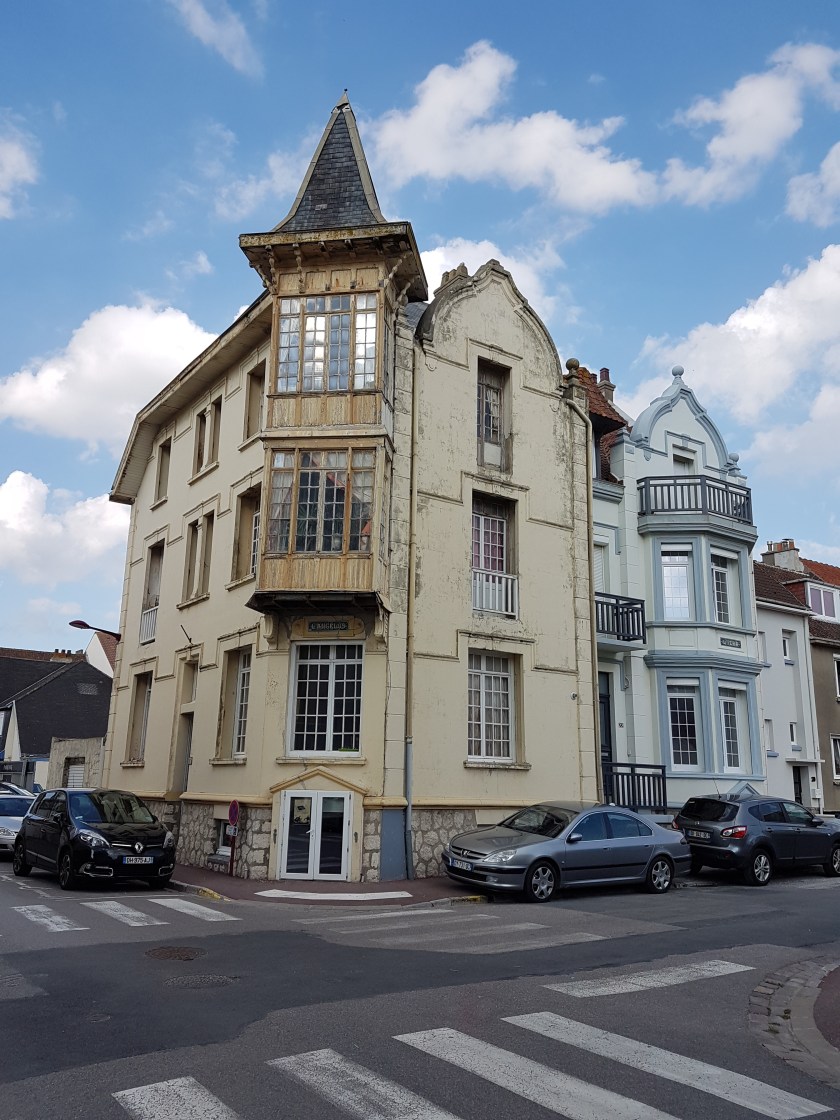
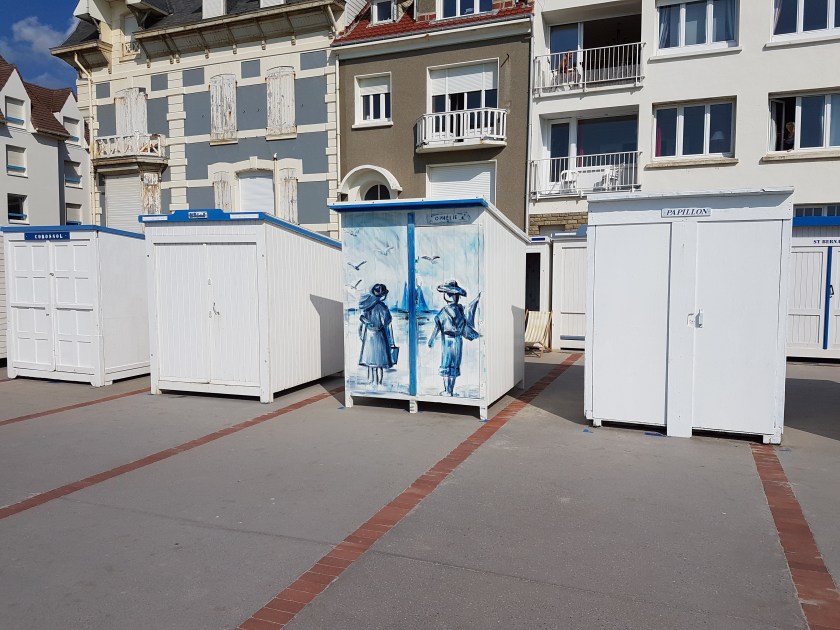
What a pretty place …
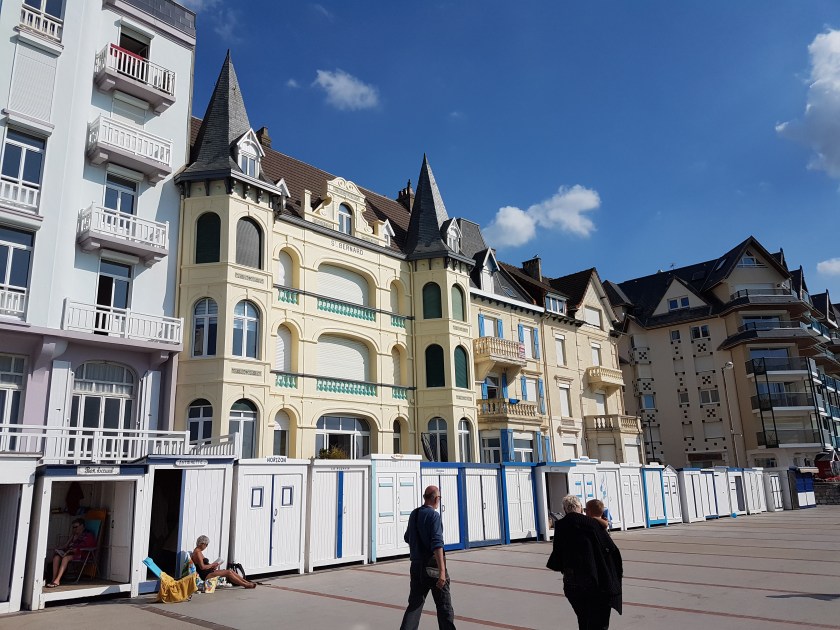
Wimereux – Apartments and Beach Huts
Some of the folks, outside these beach huts, obviously had a passion for the sun. Just an observation based on the deep tan they were sporting.
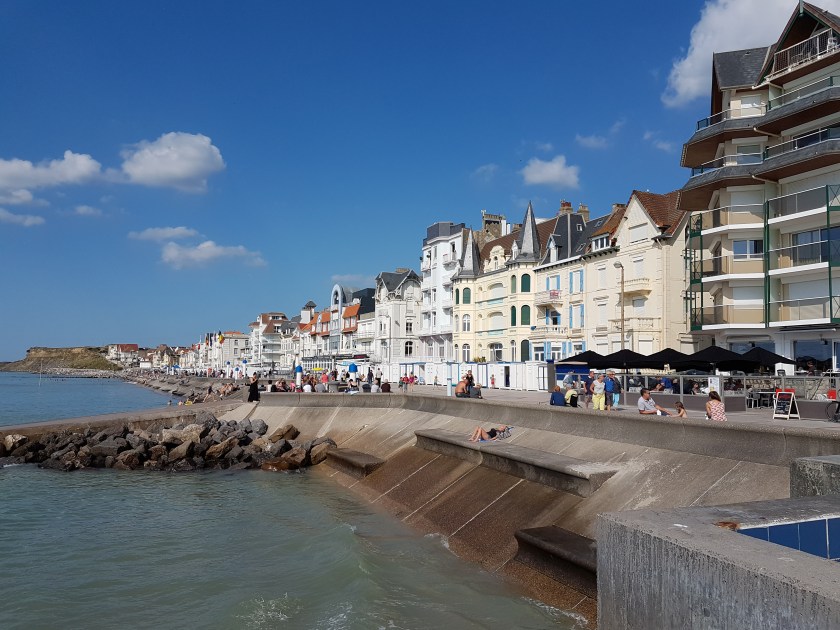
Wimereux – Beautiful Seaside Town
Lots of folks were promenading or just sitting, absorbing the suns rays. I don’t know what the sea water temperature was. But given the weather this summer I am guessing that it would be quite warm. Many people were happily swimming about.
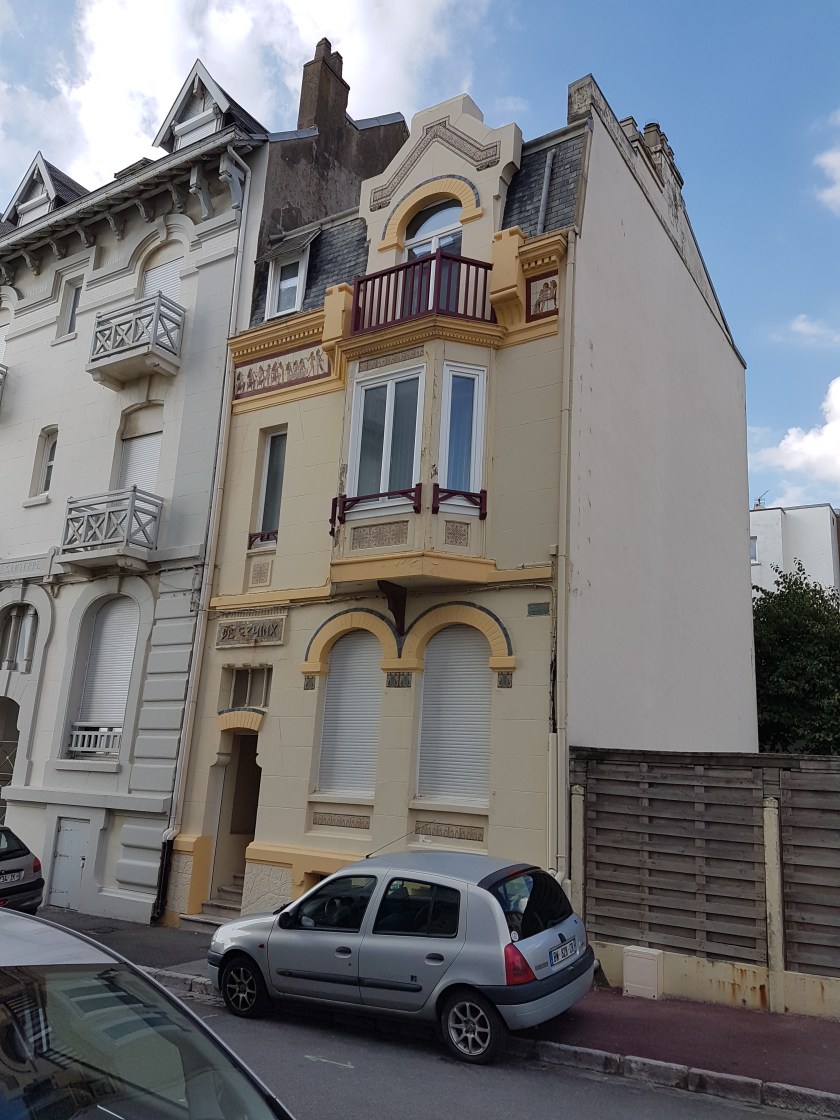
Wimereux – French style with an Egyptian flavour
According to Wikipedia ……
The seaside development was started during the Second Empire, resulting in a remarkable architectural ensemble of houses and buildings typical of the Belle Époque, which are still very well maintained to this day.
Wimereux – St LouisWimereux – Needs some TLCWimereux – Hotel L’AtlanticWimereux – Beach HutsWimereux – Colourful buildingsWimereux – Colourful and ornate
While in Wimereux we had a spot of lunch at Brasserie Les Oyats. Situated right on the promenade, we had a substantial lunch with views along the seafront and out to sea.
After a gentle stroll along the prom, enjoying the sunshine and the fresh sea air, we decided to head back to the B&B to check in.
The satnag got us there in no time and we introduced ourselves to our host who showed us to our accommodation. We were gobsmacked. We had been expecting a room with en-suite.
What we actually got was a small, one bedroom cottage. All that was missing was a kitchen. We had our own front door and even had our own terrace with sun loungers , accessed through the back door.
Once we were installed, we made tea and sat out on the terrace which was benefitting from the clear skies and sunshine. Across the terrace there is an orchard and from under the trees came a flock of chickens, coming to investigate the strangers.
The cockerel kept his distance, but kept a watchful eye while the hens came in search of food around our deck chairs. One, a plump white hen, even followed me when I took a stroll across the grass to take a look out over the fields.
I jokingly said I would steal her to take to our gite, a kind of chicken dinner carry-out.
It was nice to be relaxing after our earlier drive.
I am the eldest of three siblings and have two younger sisters. Years ago, due to job seeking, I moved away from the family home, in Sussex, eventually settling in Hampshire. Only 90 miles or so away, but far enough that our get togethers are irregular at best. We all have busy lives and trying to coordinate a gathering around our diaries is like herding cats. What we tend to do is pick a place of interest, somewhere between our respective homes, then meet up for the day. The main criteria being that there are nice walks in the grounds, interesting stately homes to explore and so forth. Also key is that there is a decent cafe / tea room or pub. Past venues for these family gatherings have been:
Chartwell – Family home and garden of Sir Winston Churchill. Chartwell was the much-loved Churchill family home from 1922 and the place from which Sir Winston drew inspiration until the end of his life
Nymans – A garden lovers’ home for all seasons, with an extensive yet intimate garden set around a romantic house and ruins. Nymans was a country retreat for the creative Messel family, and has views stretching out across the Sussex Weald
Wakehurst Place. Part of the Royal Botanic Gardens Kew, this wild botanic garden on the High Weald of West Sussex has over 500 acres of beautiful ornamental gardens, woodlands and a nature reserve. Wakehurst is also home to the Millennium Seed Bank, the largest wild seed conservation project in the world.
Bodiam Castle – Archetypal 14th century moated castle with ruined interior – a glimpse of medieval splendour. Set in the heart of an historic landscape, with spiral staircases, battlements and a portcullis, 14th century Bodiam Castle is one of Britain’s most picturesque and romantic ancient monuments.
Come and discover rescued rural homes and buildings set in a beautiful landscape, which tell the stories of the people who lived and worked in them over 1,000 years.
Enjoy our family friendly 40-acre site and visit our collection of historic buildings – we have more than 50 to explore from a replica Anglo-Saxon hall house to an Edwardian tin tabernacle church. There is a regular programme of demonstrations, including milling in our 17th century watermill; cooking in our Tudor kitchen; blacksmithing in our Victorian smithy; plus seasonal demonstrations. Take a walk in the woods, bring the dog (we are dog-friendly), visit our waterside café (also dog-friendly) or enjoy your own picnic.
North Cray Medieval House & Lavant Building
As is our normal practice, we met in the cafe, and set about orienting ourselves while downing a cuppa.
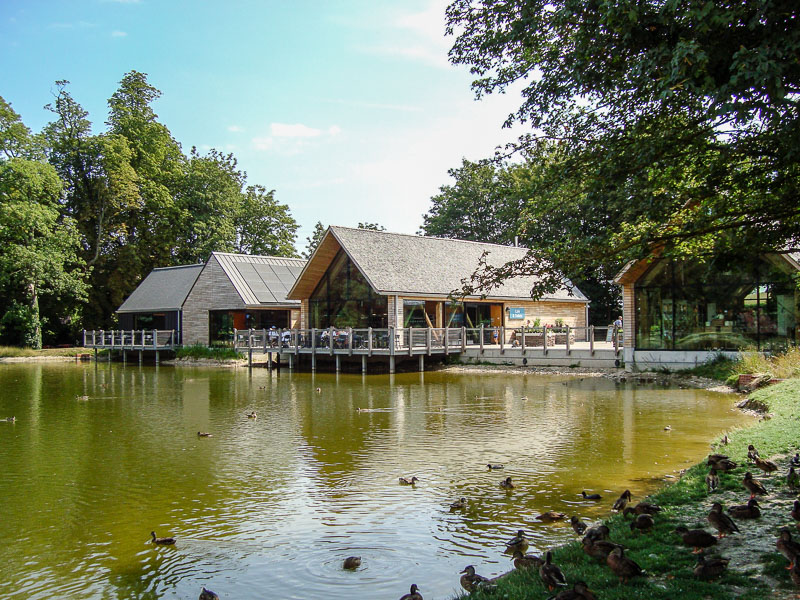
Lakeside Cafe
The nice thing about this location, is the fact that it is constantly growing. Gerry and I have visited on several previous occasions and it is always different, there is always something new.
A prime example of the new is the dairy building below. Still under construction / restoration, this building dates from c1807 and originates from Eastwick Park, Surrey.
Dairy – Eastwick Park, Surrey
Dairy – Eastwick Park, Surrey
As stated above, there are over 40 acres of grounds with buildings spread all over. From my memory, one of the earliest buildings that we have visited is the mill.
Lurgashall Watermill – Spares ?
Lurgashall Watermill – Hands on demonstration. One hours hand grinding would produce enough flour for a single loaf.
Lurgashall Watermill
Lurgashall Watermill – The power from the wheel goes here.
Lurgashall Watermill – Power source
The Weald and Downland Museum regularly appears on TV and there is a current series being broadcast. As they were filming something for that series part of the site was off-limits. Didn’t stop me taking a couple of pictures though.
Court Barn from Lee-on-Solent
Filming inside Wiston Wagon Shed
My grandfather worked the land, using horses, in the county of Sussex around Lancing, Worthing and Sompting. It is entirely possible that he may have visited this Victorian Smithy, from Southwater, during his working years.
Victorian Smithy from Southwater
Victorian Smithy from Southwater
Victorian Smithy from Southwater
Victorian Smithy from Southwater
We should consider ourselves very lucky, with all the technology and heavy machinery at our disposal. Back in the day things were very different, the work hard and often back-breaking. For example, does anyone fancy working a saw-pit ?
Saw-Pit from Sheffield Park
At least the workers would have had shelter from the rain or sun. The building here is 19th century and provided cover over a permanent saw-pit on the Sheffield Park estate.
Some of the hard labour was delegated to animals. Here is an example of a 19th century “horse-gin” from Patching, Sussex.
19th Century “horse-gin” from Patching, Sussex
“gin” appears to be a contraction of the word “engine”. Such devices were used to drive threshers or churns, but could also be used to pump water or raise coal or miners from mines. The example below was used to mix the “pug” for making bricks.
Redford Pug Mill
Not all the buildings here are industrial or agricultural. After all that physical labour the spiritual needs of the workers would have to be catered for.
South Wonston Church – Built 1908, 30 feet long by 15 feet wide
South Wonston Church – Built 1908, 30 feet long by 15 feet wide
Many trades are reflected in the various buildings here, plumbing ….
Newick Plumbers Workshop
Newick Plumbers Workshop
shop-keeping ….
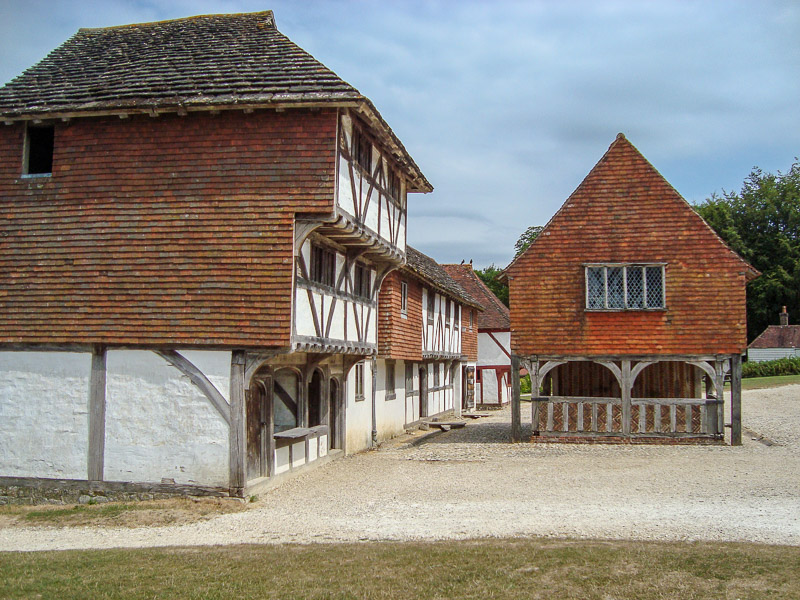
To the left is Horsham Medieval Shop, Front and centre is Titchfield Market Hall
Also on display are a number of residential buildings. The following pictures are of Whittakers Cottages, built in Ashtead during the mid 1860s.
Whittakers Cottages – Privvy
Whittakers Cottages
Whittakers Cottages – Bedroom
Whittakers Cottages – Bedroom
Whittakers Cottages – Bedroom
Whittakers Cottages – Privvy
Also on display are various wagons, animal boxes and so forth….
Sussex Wagon
Cattle Transporter built 1911
Timber “Bob” – Used to haul large logs
Dorset Wagon c1848
This house was removed and resurrected from Walderton, Sussex. The flint and brick exterior date from early to mid 17th century. However, the insides are what remains of a medieval timber-framed building.
17c House from Walderton, Sussex
Garden of 17c House from Walderton, Sussex
17c House from Walderton, Sussex
Garden 17c House from Walderton, Sussex
Below is a 19th century Stable from West Wittering, currently be used as a Potting Shed …
Potting shed contents
19th Century Stable from West Wittering. Now being used as a potting shed
Potting shed contents
The following building was originally a cart shed but it was converted into a schoolhouse.
School c1851 – West Wittering
School c1851 – West Wittering
For some years up to 1851 it was used as a school for “six poor children from the parish of West Wittering”.
The museum is also home for a number of animals including horses, oxen, chickens and ducks.
This is the proud Percheron mother of a foal, just two and a half weeks old.
By the time we arrived at the foals enclosure a storm was moving in. Thunder rumbling and lightening flashing. The foal didn’t seem to be fazed by the noise but mum was obviously aware. When the rain started, the foal was frolicking around, galloping and leaping in the air. Considering that the foal had never experienced rain this was a joyful moment.
With the rain looking like it was in for the remainder of the day we headed along the high path back to the cafe. We were presented with the following views through the rain …
Back at the cafe we had a nice cuppa and a slice of flapjack before saying our good-byes and heading home.
It was a good day and I for one am looking forward to the next visit.
Continuing a theme of stepping back in time, today’s post is about the Bluebell Railway which runs between East Grinstead & Sheffield Park in East Sussex.
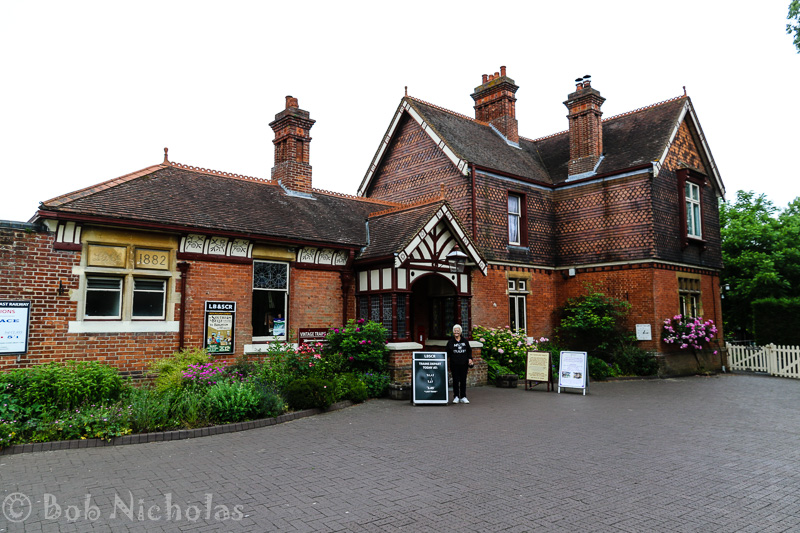
Bluebell Railway – Sheffield Park Station
This was another “wrinklies” trip, organised by the IBM Retired Employees Club. And what a fine day out it was.
A coach trip through some of the finest countryside that Hampshire and Sussex have to offer. You see so much more from the high vantage point that a coach provides. Seeing much that is missed, hidden behind hedgerows when sitting in a car.
On arrival at Sheffield Park, we had time to wander the station, the gift shop and cafe.
Bluebell Line – Sheffield Park – Platform view with some rolling stock in the distance.
Over to the right you can just make out a brown locomotive. This is the Fenchurch, the oldest engine on the Bluebell Line.
Bluebell Line – Fenchurch
Bluebell Line – Fenchurch footplate
Bluebell Line – Fenchurch
Fenchurch was built in 1872 for the London Brighton and South Coast Railway.
It was sold in 1898 to the Newhaven Harbour Company where it worked for many years. It finished its working life on the Hayling Island branch where the light weight, at 28 tons, was valuable due to the limits on the bridge over the estuary.
Whilst wandering the platforms, browsing the souvenir shop and raiding the restaurant for some chilled water, our train arrived.
The walls of the station buildings are adorned with the advertising posters of yesteryear, many stirring quite strong memories.
Back when there were 240 pennies to the pound !!!
Bluebell Line – Sheffield Park – Engine 847
Bluebell Line – Sheffield Park – Engine 847
Bluebell Line – Sheffield Park – Engine 847
Before we could board, the existing passengers had to disembark, and then the engine had to be moved from the one end of the train to the other.
Heading up to the front of the train
Disconnected from the train, reversing down to the points, to change lines.
Switching the points
Heading up to the front of the train
Bluebell Line – Sheffield Park – “All change”, end of the line.
While the engine swapped ends the carriage for our group was also being prepared for our luncheon. We were to enjoy a ploughman’s lunch and fresh brewed tea.
Time to take on some water. Hauling trains is thirsty work for our steam engine.
Carriage with destination board listing the stations on our journey
Once our engine was re-attached to our train there was just time for a few more shots before boarding.
Steaming
Each piece marked for this specific locomotive
Engineering or Art ?
The footplate for our engine is a bit more complicated that that of Fenchurch
And then we were off. Not the smooth running of todays diesel/electric trains. Rather a gentle pulsing which comes from the steam-driven pistons driving our locomotives wheels. Then there was the aroma, coal fire mixed with steam. Once experienced, never forgotten.
The line passes through some beautiful countryside. We saw cows, sheep, quite a few pheasants. I even saw, what I assumed was an owl box, shaped like the gable end of barn, mounted in a tree close by the railway.
We were sat across our table from a nice couple of gents with whom we nattered about all manner of subjects. We all enjoyed our ploughman’s lunch although perhaps it would have been more appropriate to have had an engine drivers breakfast. Bacon, sausage, eggs and toast cooked on a shovel in the firebox. But I guess that would have been too much to ask for. Even the tea could have made using steam from the boiler.
Ah well, perhaps another time. All too soon our journey was over and we all left the train and headed back to our coach for the drive home.
Journeys End – an almost deserted platform
And finally, when we had a nationalised railway system, we all moaned and wished we could go back to the days of the independent and local railway companies. Now we have a national rail network with franchised companies running the trains. With the current, recurring railway network chaos headlining our newspapers and television news, it seems we are all wishing we had our old nationalised system under British Railways ……
As an IBM retiree, I am a member of the IBM Retired Employee Club. The club organises various activities to keep us occupied, mainly via organised excursions. These activities can vary from shopping trips to London, mystery coach rides through the British countryside, shows and visits to stately homes.
Canal Side Flowers
A couple of weeks ago we did something a little different, for us. The scheduled excursion was a trip to the old market town of Marlborough, combined with a horse-drawn boat trip on the Kennet and Avon canal.
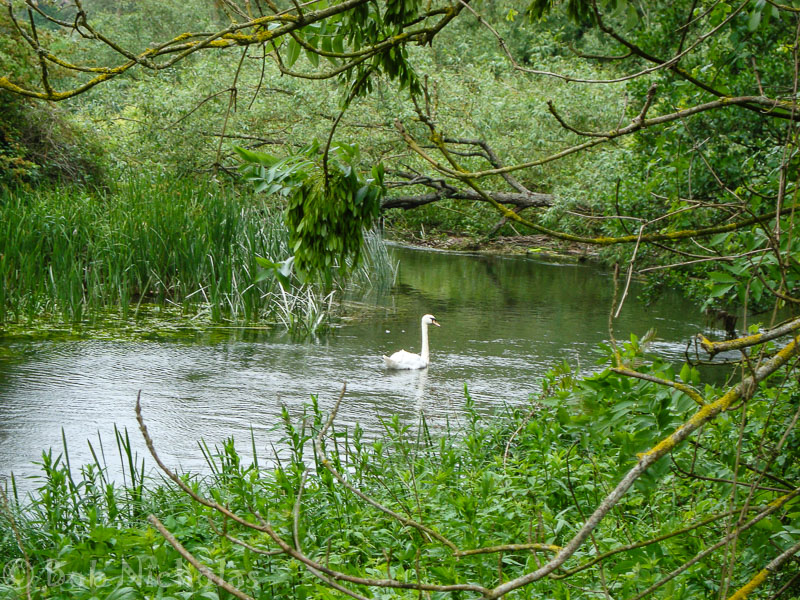
Tranquility
So, reasonably early in the morning, we set of on the coach. It was quite a dull day, in fact it rained quite hard as we drove down the M27. This didn’t bode well for the time we were due to spend in Marlborough. Plodding around shops is not my idea of fun. Doing it in the rain, even less so. However, 90 minutes or so later we arrived at Marlborough High Street, the second widest in Britain. The rain had eased off to a light drizzle so that was good.
Marlborough is an interesting town but, since we have visited several times before, we opted to spend very little time window shopping. Instead searching out a cozy hostelry, namely the Castle & Ball hotel, which dates from the 15th century. Here we had a very pleasant meal.
Having completed our lunch, we were soon back on the coach, ready for the days highlight, the boat trip. And, after a short, thirty minute drive, we arrived at Kintbury and were soon aboard the canal boat.
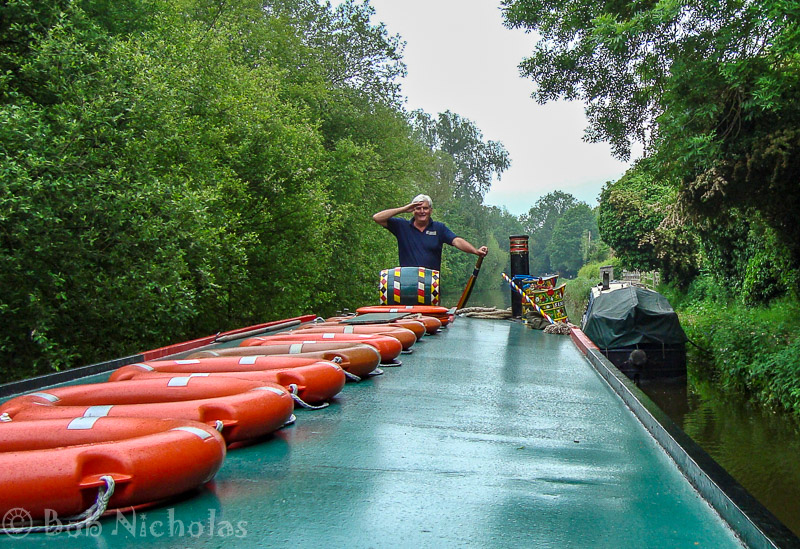
Kennet Valley – Our 1 Horse Power canal boat
Our horse-drawn boat, Kennet Valley, is a wide-beam passenger vessel, purpose-built in 1976. She operates from Kintbury and is 20.4m (67ft) long by 3m (10ft) wide. Powered solely by the 1hp towing action of a horse.
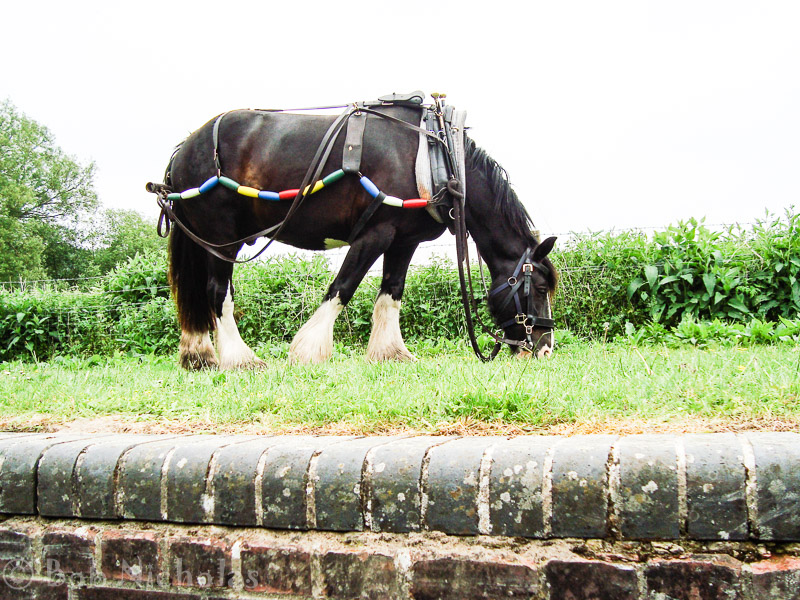
Monty ‘The Star’ – a Welsh Cob Shire Cross
The horse in question is Monty ‘The Star’ a Welsh Cob Shire Cross. He was ready and harnessed when we arrived. Shortly, after all passengers were aboard, Monty was hitched up and off we went.
Regular Stretching Exercises – Keeping The Rope Clear
This is a fabulous way to travel. So smooth and quiet. Sometimes, there are obstacles to negotiate. The guys, our crew of three, were very adept. Lifting the tow rope over other craft moored alongside, so as not to take down their chimneys ……..
Aye Aye Skipper
….. steering to avoid oncoming craft. Yes it was very busy. I think during our three hours on the boat we encountered two other craft coming towards us. I think the rules were that, since we were under horse power, they had to give way to us. …..
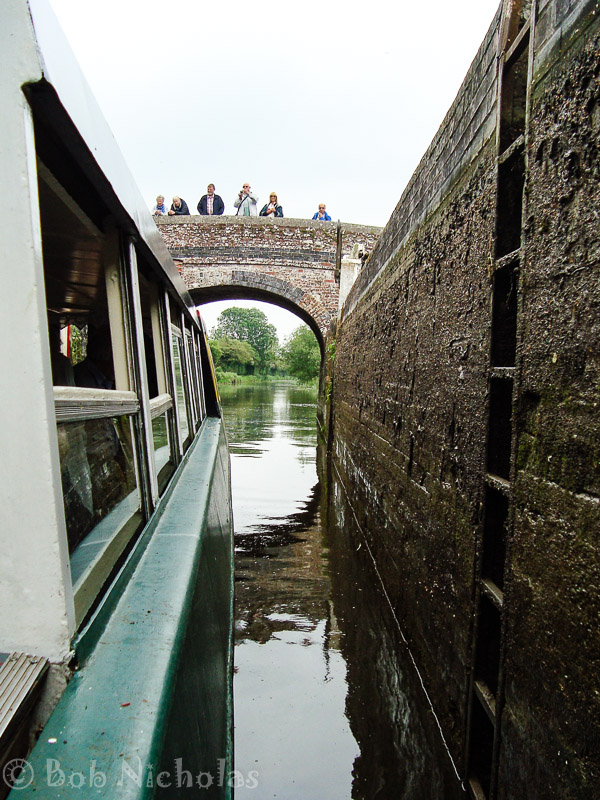
…. Locks are an intrinsic part of the canal way of life. During our journey we had two locks to negotiate each way ….
Passing Through The Lock
….. and bridges too.
Between locks, some of us decided to jump ship and walk alongside the canal. This was so relaxing.
Threading the canal boat through the eye of the needle
If there hadn’t been some fifty odd passengers chattering away, this would have been a very quiet journey.
About half way through our journey, the galley was opened and we were served a fabulous tea. Hot tea and coffee along with Walnut Cake, Victoria Sponge and Lemon Drizzle Cake. Best of all we were treated to Fruit Scones with Cherry Jam and Cream. Surprisingly, the chatter level increased with everyone enthusing about the quality of the fare.
However, even with all that chatter, this was a lovely way to travel. No monotonous engine drone, no exhaust fumes, just the fresh country air. All accompanied by the bleating of lambs in the fields and the birdsong to join us on our gentle glide along the canal.
Monty walked steadily along, grabbing mouthfuls of grass and other foliage at every opportunity. Literally, foraging on the hoof. During our journey, we were regaled with tales of how, on a previous “wrinklies” trip, Monty did a runner. When Monty was un-hitched to allow the boat through one of the locks, he decided he had had enough and took off along the canal-side, all the way home. This left the boat stranded while the skipper trotted back home to retrieve Monty and bring him back to finish his days work.
On this occasion he behaved himself. Our journey was all to soon completed and we were back on the coach. Safely back to our departure point and then on to home.
This was to be our last venture out before heading for home. As usual the weather forecast was mixed but, fingers crossed, we headed out. But, not before a couple of pictures taken from our hotel room.
The Jetty, Towers Hotel – Intrepid travellers waiting to board the shuttle boat to Sorrento
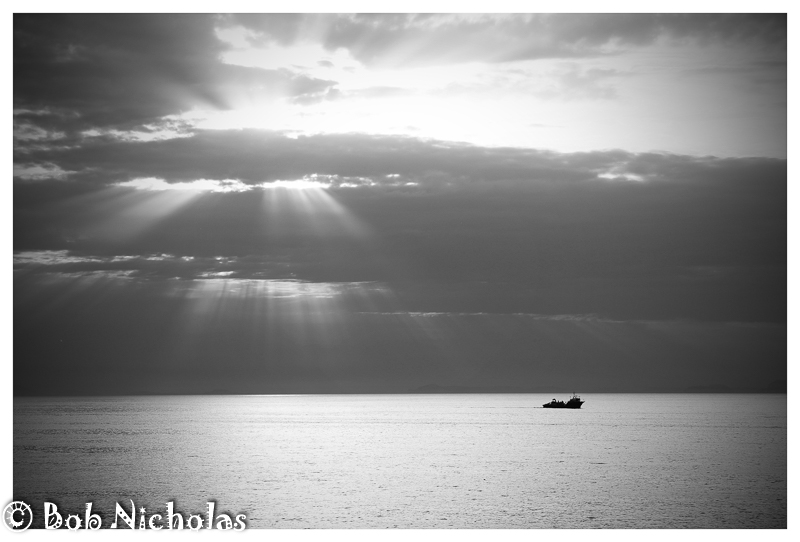
Local fishermen, a daily feature , just off the hotel shoreline
Shuttle boat, under power, on its way to Sorrento
Our target destination was the Olivenbaum, at Marciano down near the tip of the Sorrento peninsula. As far as we could determine this is a piece of “folk art” initiated and maintained by the local villagers.
The satnag took us out from our hotel, weaving through Vico Equense, Montechiaro and Meta along the usual route to Sorrento.
From here we headed out into the countryside, into unknown territory. Needless to say we were presented with many beautiful views, although there wasn’t always anywhere to safely pull over and get the camera out. We did get some pictures ……
Looking over Massa Lubrense and Marina Lobra with Vesuvius just showing in the background
Looking over Massa Lubrense
Looking over Massa Lubrense to Marina Lobra
Looking over Massa Lubrense with Vesuvius just showing in the background
and there is more ……
Chiesa di Santa Maria della Neve
Cemetary – Chiesa di Santa Maria della Neve
The church and cemetery were situated on, by far, the quietest road that we had driven during our stay in Italy.
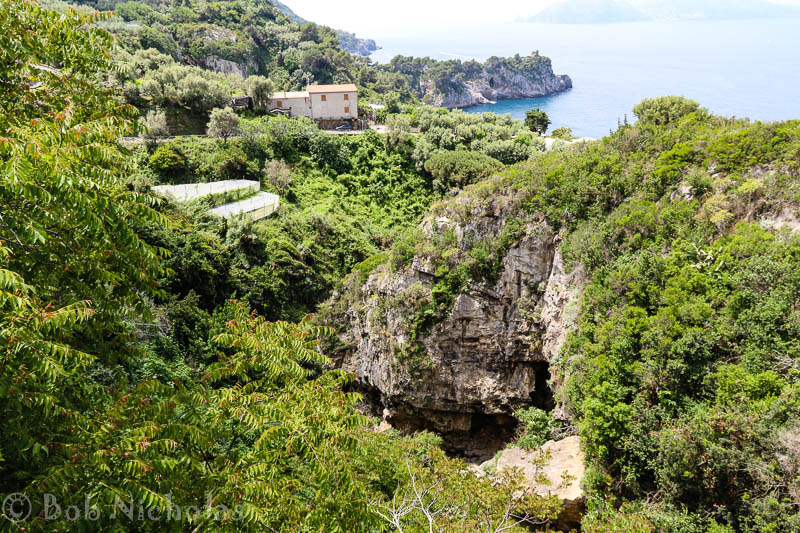
View from via Nastro d Oro, over a small gorge, towards Capri
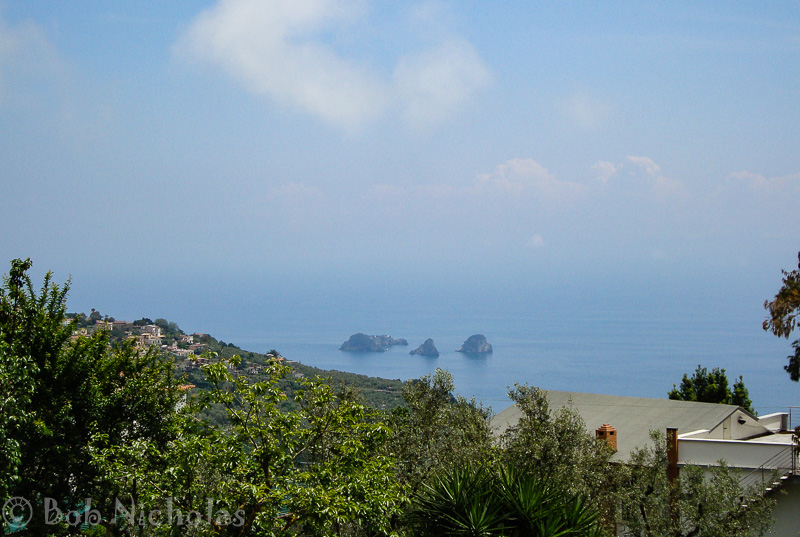
The following picture, taken by Gerry, shows three rocky islands …. The Sirenusas
The Sirenusas – Gallo Lungo – Il Gallo Lungo, La Castelluccia & La Rotonda
So named as legend has it they were inhabited by sirens. The most famous of whom were Parthenope, Leucosia, and Ligeia. One of them played the lyre, another sang, and another played the flute.
In more recent times the islands have been owned by Rudolph Nureyev, purchased in 1988. Following his death, they were purchased by a local Sorrento hotelier.
According to Wikipedia: The property has been on and off the market for years, most recently a public listing of the three islands in 2011 was for US$268,000,000.
We never did find the Olive Tree. The satnag led us round in circles, telling us to turn when there wasn’t a turning. On one occasion we came across a narrow road/track, which might have taken us there but the road signs were confusing. Implying no vehicular access. Since there were no signs regarding the Olive Tree, we didn’t fancy hoofing it into the unknown.
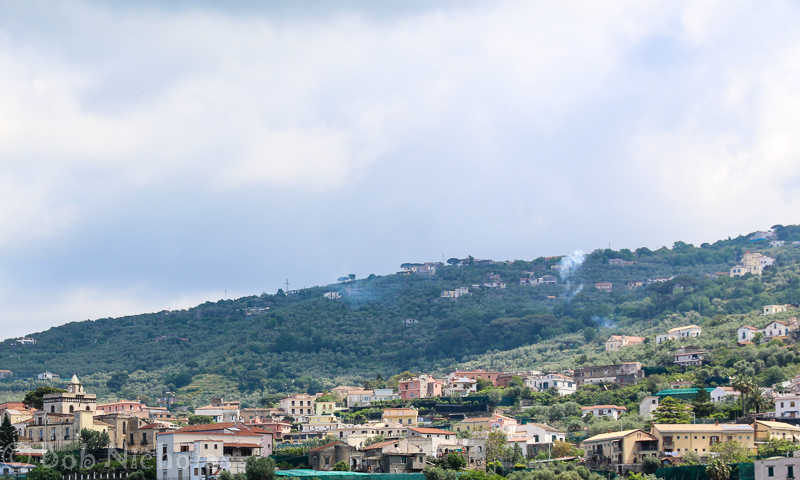
Never mind, we were enjoying the views, the peace and quiet of the countryside. Well, peace for the most part. However, we were treated to a 21 gun salute. We had seen some signs for a military establishment and they were evidently practicing with their cannon. The puffs of smoke can just be seen in the following photo …
Gun smoke ?
As I said this was our final day exploring the Sorrento Peninsula. Sadly, it was soon time to head back to the hotel and the inevitable suitcase packing.
Just time for one more shot of Vesuvius, across the bay from our hotel ….
Mount Vesuvius – Viewed from Towers Hotel
So that is it, the end of our Italian Adventure.
Well not quite, our journey to the airport was nearly as complicated as driving to the hotel on day one. However, we made it to the airport, eventually found our way into the car rental compound and ultimately made our flight back to the UK and home. It was amazing how rush hour on the M25 seemed so tranquil, compared to the roads around Naples and Sorrento. And quiet, not on single toot of a car horn. And so few motor cycles.
Having previously, either passed through, or ricocheted off Sorrento, we thought it was time to pay this busy town a visit.
Sorrento – Piazzo Tasso
Sorrento – Piazzo Tasso
Sorrento – Piazzo Tasso
Sorrento – Piazzo Tasso
We found a convenient car park, in via Ernesto de Curtis, near the Circumvesuviana station. After a short walk, through Piazza Angelina Lauro, and browsing the nearby shops, we made our way to Piazza Tasso.
Sorrento – I want this villa
Sorrento – Piazza Tasso
Sorrento – I want this villa
Sorrento – via Luigi de Maio, the road to the port and where we parked on our day to Capri
The Piazza has many eateries and we selected Bar Syrenuse as the venue for our lunch. Not the best choice as it turned out.
I chose this venue for my first “real” Italian Pizza. As it happens, I think it was probably the worst pizza I have had and that is in comparison to a Tescos own brand pizza.. Flavour-wise it was fine but the sauce was sloppy and the base soft. Could only eat it with a knife and fork. Gerry had ordered a chicken sandwich and the bread was stale. Still the drinks were cold and very good.
After lunch we continued our tour and were soon passing shops / art galleries displaying Capo di Monte
Away from the main roads we found small parks where one could regather your thoughts after doing battle with the cars and scooters.
Sorrento – Piazza Sant Antonino
Sorrento – Piazza Sant Antonino
Sorrento – Piazza Tasso
Various kinds of wall art …
Sorrento – Graffiti or Art
Sorrento – Example of wall art from Ceramica Artistica
Sorrento – Example of wall art from Ceramica Artistica
Sorrento – On wall in via S. Francesco
From Sorrentos Park Villa Comunale the views are superb. Whether looking down on the commercial beaches with their sun loungers and pretty umbrellas, or looking out across the Bay of Naples
Sorrento – View From Park Villa Comunale
Sorrento – Peters Beach with Porto di Sorrento Viewed From Park Villa Comunale
Sorrento – View From Park Villa Comunale
Sorrento – Marameo Beach Viewed From Park Villa Comunale
Sorrento – Bagni Salvatore Viewed From Park Villa Comunale
Sorrento – Silver Whisper Viewed From Park Villa Comunale
Heading to the view-point we were drawn by some rather pleasant violin playing, coming from this beautiful courtyard….
Sorrento – Catholic Church, Convento di San Francesco
The music was part of a wedding event. The happy couple can just be seen in the background, and here I have cropped in closer ….
Wedding couple – Sorrento – Catholic Church, Convento di San Francesco
They had lovely weather for their wedding, lucky given the mixture of dull, cloudy and rainy days during the last week.
Now here are a couple of rare shots, I’m usually the one behind the camera.
Sorrento – Yours truly
Sorrento – The boss
Now you are over the shock, me too, it’s time to move on.
After a cold drink to bid Sorrento goodbye, we headed back to our hotel where we were treated to the Vesuvius summit playing peek-a-boo through the clouds. And then a superb sunset.
Sunset – From Towers Hotel, Castellamare di Stabia
Vesuvius – From Towers Hotel, Castellamare di Stabia
Vesuvius – From Towers Hotel, Castellamare di Stabia
Sunset – From Towers Hotel, Castellamare di Stabia
Vesuvius – From Towers Hotel, Castellamare di Stabia
Sunset – From Towers Hotel, Castellamare di Stabia
We were up reasonably early today, Monday 7th, as our coach was picking us up at 08:50. As it happens, they arrived about twenty minutes late but never mind, this wasn’t to be a long journey and we had been sat chatting in the hotel lounge.
So today we were going on a guided tour of the archaeological site that is ancient Pompeii.
For those of you who don’t know …….. From Wikipedia …..
Pompeii was an ancient Roman town-city near modern Naples, in the Campania region of Italy, in the territory of the comune of Pompei. Pompeii, along with Herculaneum and many villas in the surrounding area, was mostly destroyed and buried under 4 to 6 m (13 to 20 ft) of volcanic ash and pumice in the eruption of Mount Vesuvius in AD 79.
Pompeii is vast, it covers a total of 64 to 67 hectares (170 acres) and was home to approximately 11,000 to 11,500 people on the basis of household counts of the time.
Pompeii was not engulfed in a huge lava flow, rather it was enveloped in layer upon layer of volcanic ash. The victims died through asphyxiation. It is because of the ash that so much has been preserved.
Pompeii – Ancient Roman Tourist queuing to buy souvenirs ?
We were on a guided tour with the usual radio head sets. Our guide was very good, with lots of information about what we were seeing. Unfortunately my little grey cells are not up to the job of retaining all she said. The following is a selection of the photos I took. Where I can, I have included snippets of information that I remember, supplemented by a little research of my own.
Pompeii – This larger than life character “Daedalus” looks down near the entrance to the site. I expect he’s wondering about all the tourist tat shops Perhaps wishing Vesuvius would bury the lot of them
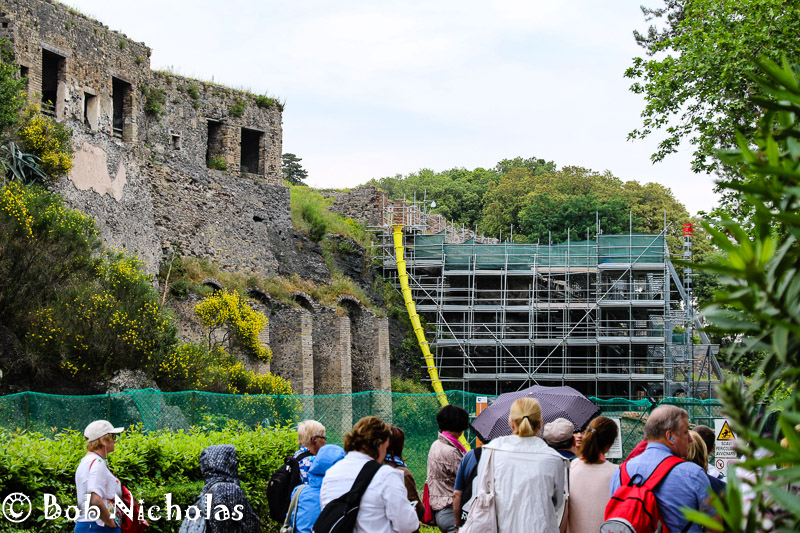
What you see in Pompeii isn’t all as it was found. Some parts have been re-constructed and, as seems to be the case wherever I travel, there are some areas covered with scaffolding.
Pompeii – It’ll look great when the construction work is finished
The streets of Pompeii were built to last, to withstand the passage of wheeled chariots and carts. They were also the place where every kind of effluvia ended up. Be it rain water, horse droppings, human waste and the general detritus discarded by the population of the city.
Pompeii – Street scene
Pompeii – Street scene
Pompeii – Street scene
Pompeii – Street scene
Pompeii – Street scene. Note the large blocks across the street. These are stepping stones, pedestrian crossings to enable the citizens of Popeii to avoid the detritus that would running down the road.
Pompeii – Street scene
Many of the streets had large raised blocks across the width of the street. These were the Pompeii equivalent of a pedestrian crossing, There to help Pompeiis citizens avoid splashing through who knows what.
Many of the streets in Pompeii were not wide enough for two-way traffic. In fact, none of the streets in Pompeii are wider than 3 meters across, and it is believed that such streets may have been permanently designated as one-way. No signs to support this theory have been found. However, by looking at the wear patterns of the ruts, archaeologists have been able to identify the predominant direction from some of the streets.
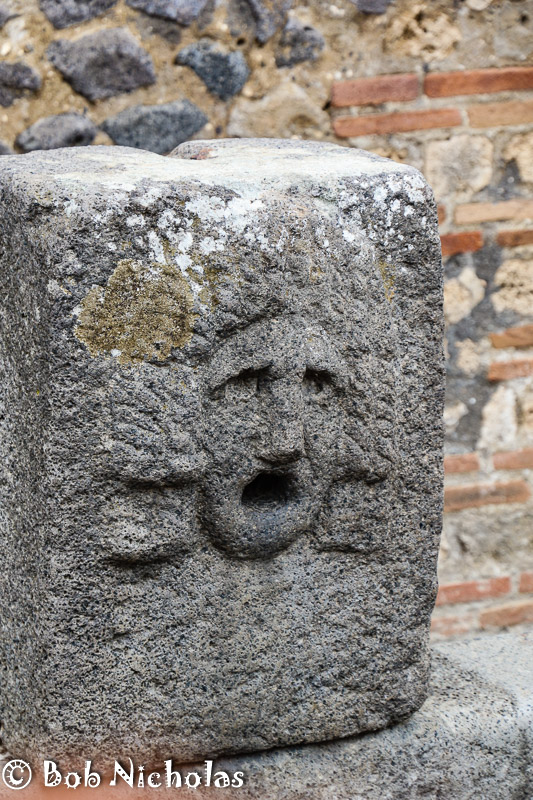
Pompeii – Water Fountain
Water is fundamental to all life and no less so for the citizenry of Pompeii. Only the richest residents would have had water supplied to their houses. Everyone else would have relied on public fountains. Fountains, such as the one above, would be found at most street corners.
Another water related fact is that the citizens of Pompeii were not very tall. This is put down to the amount of lead used in the water systems. Lead pipes that fed the water fountains and also the richer homes. Water storage tanks were also made of or lined with lead. Apparently lead can stunt growth. However, there is a counter argument that says the amount of calcium in the water would have led to the calcification of the pipes and tanks and that in turn would have reduced the amount of lead contamination.
Our guide made a point of informing us that the lead came from England. What she omitted to say that it was the Romans who did all the serious mining and presumably exporting most of it back home.
One of the largest homes, identified so far, in Pompeii is the House of the Faun. The house was home for a very wealthy family and takes up a whole block. It had an interior space of about 3,000 square meters (nearly 32,300 square feet).
Pompeii – The Small Peristyle, House of the Faun
Pompeii – The House Of The Faun. The house is named after this statue, although this is just a replica of the original.
Pompeii – The House Of The Faun. The house is named after this statue, although this is just a replica of the original.
Pompeii – House of the Faun
Pompeii – House of the Faun, Alexander Mosaic
The large mosaic in the picture above is the Alexander Mosaic Follow the link to Wikipedia for a better picture and more information.
The photo above, with the columns, is the smaller of two peristyles. A peristyle is an open space surrounded by columns. Even the smallest is not insignificant, being about 20 meters (65 feet) by 7 meters (23 feet). The current reconstruction of this peristyle includes a formal garden. It may or may not have been a formal garden when it was originally in use.
Time for a little moan. The House Of The Faun is one of the most popular places to visit in Pompeii. There are two gateways and if they had put both of them to use there would have been a better pedestrian flow. Instead folks were trying to get in and out of just the one, narrow, gateway. A lack of courtesy meant that the flow would be only one way for quite some time.
Another popular building to visit is the Lupanare or brothel. I never thought it would happen, but I took my wife to a brothel. A great deal, was made by our guide, about the saucy images that we would see on the walls within the building. So much so, that a family group with two young boys were considering not taking them through.
Pompeii – Lupanare – Erotic Scene
Pompeii – Lupanare
Pompeii – Brothel bed
Pompeii – Fertility Symbol
Pompeii – Just look at the queues for the brothel (Lupanare)
Pompeii – Lupanare – Erotic Scene
They needn’t have worried, you aren’t inside for very long and what is on display, is fairly faded and difficult to interpret.
The prostitutes in the brothel would have been mostly Greek and Oriental slaves. Apparently, they were paid between two and eight Asses (a glass of wine cost one Ass)
for their services. The building has two floors. The homes of the owner and the slaves are at the top and there are five rooms at the bottom, all fitted with a built-in bed, on either side of the corridor that connects the two entrances of the ground floor. The rooms were
closed by a curtain. A latrine is at the end of the corridor, under the staircase.
Small paintings with erotic depictions on the walls of the central corridor informed customers of the activities that took place.
Our guide led us ever onwards through the maze that is Pompeiis streets. Directing our attention to various structures that have been identified as this business, or that business. Here are a couple that I can remember ….
Pompeii – Thermopolium, Fast Food Outlet. Anyone for KFC or a Big Mac
Pompeii – Bakery
Pompeii – Bakery with flour grinder to the fore and the bread oven to the rear.
The first two photos are of a bakery, showing the oven and flour mill that would have probably been operated by slaves. The third photo shows the remains of a thermopolium, effectively a fast food outlet. The Roman equivalent of a McDonald’s although the food would probably been better that a big Mac.
The residents of Pompeii were not averse to the arts and we were soon entering one of the many theatres.
The Odeon or theatrum tectum, as it was called by the Romans, was built during the early years of the colony, c79 BC.
Pompeii – Pompeii – The Odeon or theatrum tectum, decorative feature.
Pompeii – The Odeon or theatrum tectum
Pompeii – The Odeon or theatrum tectum
Pompeii – The Odeon or theatrum tectum, decorative feature, Atlas I believe.
This building was the place dedicated to the most popular theatrical genre at the time, mime. The Odeon would also be used for musical and singing performances.
Leading to the Odeon is the Quadriporticus of the theatres or Gladiators Barracks, a large quadrangle surrounded by 74 Doric grey columns, used as a foyer, an area where the spectators could stop during the intervals in the shows.
Pompeii – Gladiators Barracks
Pompeii – Gladiators Barracks
Pompeii – Gladiators Barracks
Pompeii – Gladiators Barracks
Pompeii – Gladiators Barracks
Pompeii – Gladiators Barracks
After an earthquake the building changed its function and became a barracks for gladiators. This resulted in parts of the building being reorganised. The rooms upstairs may have been the apartments of the undertaker of the gladiators. During the excavations ornamental weapons, used in the parades that preceded the battles,were found in two wooden boxes. Many victims were also found here, such as four skeletons of slaves and 18 people were found in a room, including a woman with a very rich collection of jewels.
Our party was introduced to the Stabian Baths so-called as they lie at the intersection of the Via Stabianaand the Via dell’Abbondanza.
Here the citizens of Pompeii would have made use of the cold (Frigidarium), warm (Tepidarium) and hot baths (Caldarium)
Pompeii – Stabian Baths, Frigidarium
Pompeii – Stabian Baths
Pompeii – Stabian Baths, ceiling of the Apodyterium
Pompeii – Stabian Baths, ceiling of the Apodyterium
Pompeii – Stabian Baths, Frigidarium
Pompeii – Stabian Baths, Caldarium showing where the hot air would have circulated under the raised floors
Pompeii – Stabian Baths, Ceiling of the Apodyterium
Pompeii – Stabian Baths
Pompeii – Stabian Baths, Apodyterium
Pompeii – Stabian Baths
The floor of the Caldarium would have been very hot. So hot that visitors to the baths would have to wear clogs to insulate their feet.
Much is made of the speed with which the residents of Pompeii were trapped by the pyroclastic clouds from Vesuvius. So much so, that not only were the buildings preserved, but the bodies of the inhabitants.
As the archaeological digs proceeded, throughout the years, many of these bodies have been found, or rather the cavities where the bodies had been. Basically providing a negative image in the compressed ash. By using a form of plaster of paris these forms have been revealed.
The example in the above photos is said to be of a servant / slave girl. She was also, judged by the curve of her belly, believed to have been pregnant. Very sad.
As our tour continued we arrived at The Forum, a vast area. This would have been at the political, commercial and social heart of the town.
Pompeii – Forum, part of the Arcade to the far right.
Pompeii – Forum
Pompeii – Forum
Pompeii – Forum, Centaur by late Polish artist Igor Mitoraj
Pompeii – Forum
Pompeii – Forum Arch in Honor of Nero Caesar; Arch of Caligola is in the Background.
The most important civic buildings of Pompeii would have been located here. For example, municipal offices, the basilica (court-house), the principal temples (such as the Capitolium). Also the macellum (market) would likely have been here.
After visiting the Forum it was time for our tour group to head back to the coach for our journey home. How quickly two hours passes by.
Our route to the exit leads us, once again, to the huge sculpture/statue of “Daedalus”. From whichever angle he is viewed from, he is impressive.
Pompeii – “Daedalus” by late Polish artist Igor Mitoraj
Pompeii – “Daedalus” by late Polish artist Igor Mitoraj
Pompeii – “Daedalus” by late Polish artist Igor Mitoraj
Pompeii – “Daedalus” by late Polish artist Igor Mitoraj
And finally, here are a few more photos from our visit.
Pompeii
Pompeii
Pompeii
Pompeii
Pompeii
Pompeii
Pompeii
Pompeii
Pompeii
Pompeii
Pompeii
Pompeii
Pompeii
Pompeii
Pompeii
Pompeii
Pompeii
Pompeii
I would recommend everyone, who has the opportunity, to visit Pompeii. Probably, the best way would be to do your own research before visiting, then self guide to see the key items. Since our visit I have viewed a few other blogs and websites and seen photos of items that we would have enjoyed. The guided tours have their set routes, and not everything can be covered in the two hours that we had. Unfortunately with such a tight schedule our tour was more like a route march.
Pompeii has so much to offer and I am afraid we only scratched the surface.



























 WrAnTz